Tag: PhD stipend

  • Fully Funded PhD Scholarships in Singapore: 2026 Guide for International Students

    Fully Funded PhD Scholarships in Singapore: 2026 Guide for International Students


    Introduction: Why Pursue a Fully Funded PhD in Singapore?

    Singapore has firmly established itself as one of Asia’s premier destinations for doctoral research. Home to world-ranked institutions, cutting-edge laboratories, and a thriving innovation economy, the city-state attracts thousands of international PhD applicants every year — and with good reason.

    The best part? A PhD in Singapore is, in most cases, fully funded. For international students, this means tuition fees, a competitive monthly living stipend, and often travel allowances — all covered. Whether you are a STEM researcher, a social scientist, or an engineer with a passion for discovery, Singapore’s universities and research agencies offer some of the most generous doctoral funding packages in the world.

    This comprehensive 2026 guide covers 10+ fully funded PhD scholarships in Singapore for international students, including official links, stipend amounts, eligibility criteria, and application deadlines. If you are searching for fully funded PhD positions in Singapore, this is the only guide you need.


    Are PhDs in Singapore Fully Funded for International Students?

    Yes — in most cases. The majority of PhD programmes at Singapore’s autonomous universities (NUS, NTU, SUTD, SMU, and SIT) come with scholarship packages that cover:

    • Full tuition fee waiver
    • Monthly stipend (typically SGD 2,000–3,600 depending on scholarship and stage)
    • Settling-in allowance (one-time, on arrival)
    • Airfare grant (for select scholarships)
    • Medical insurance (varies by institution)

    The key is to apply for the right scholarship alongside your PhD admission. Most funding is awarded automatically when you are admitted — but competitive fellowships like SINGA and the NUS President’s Graduate Fellowship require a separate application.

    Looking for opportunities in other regions? See our guide on Fully Funded PhD Scholarships in Europe for Indian Students (2026) and Fully Funded PhD Scholarships in Canada for Indian Students (2026).


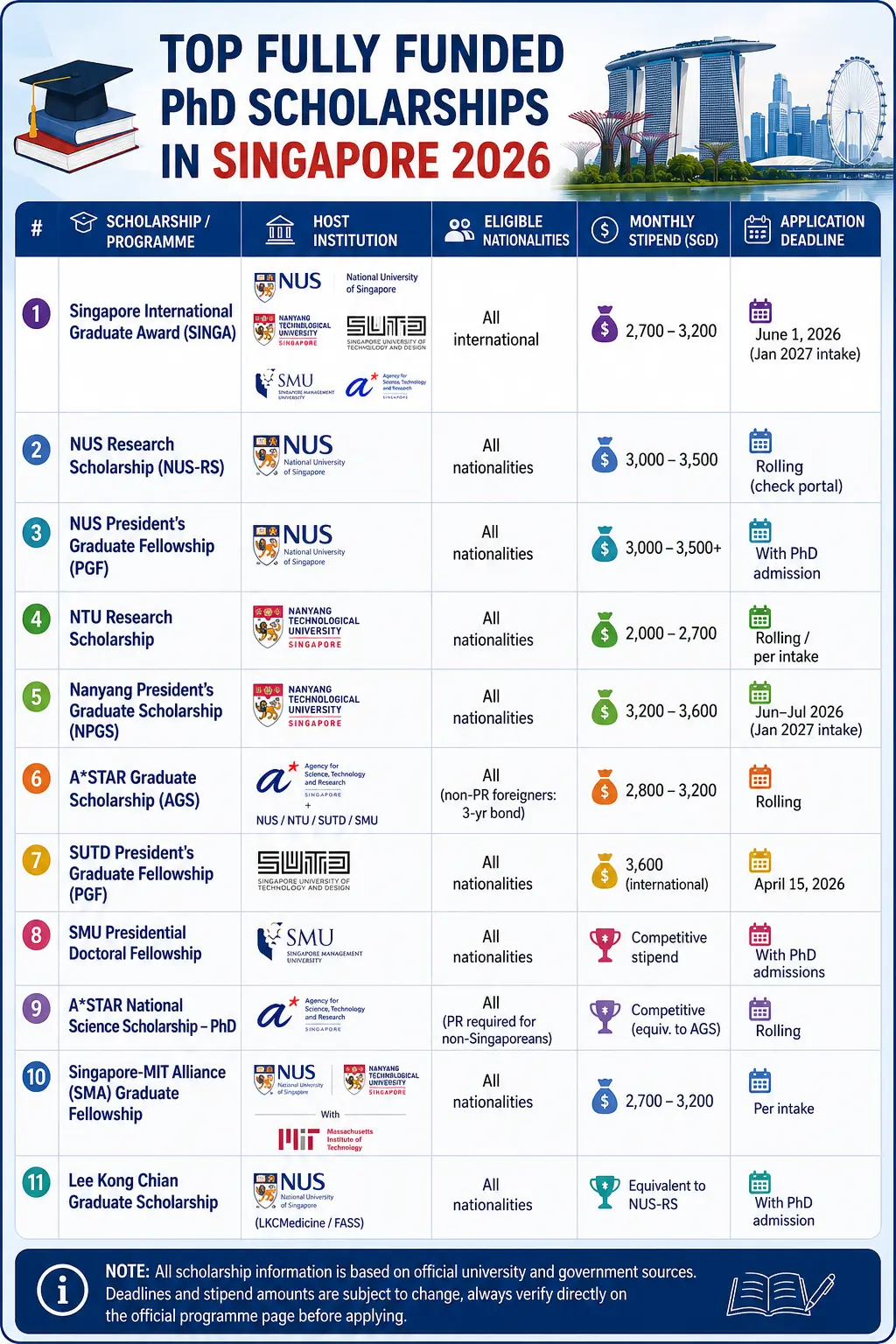
    Summary Table: Top Fully Funded PhD Scholarships in Singapore 2026

    #Scholarship / ProgrammeHost InstitutionEligible NationalitiesMonthly StipendApplication DeadlineOfficial Link
    1Singapore International Graduate Award (SINGA)NUS, NTU, SUTD, SMU, A*STARAll internationalSGD 2,700–3,200June 1, 2026 (Jan 2027 intake)singa.a-star.edu.sg
    2NUS Research Scholarship (NUS-RS)National University of SingaporeAll nationalitiesSGD 3,000–3,500Rolling (check portal)nusgs.nus.edu.sg
    3NUS President’s Graduate Fellowship (PGF)National University of SingaporeAll nationalitiesSGD 3,000–3,500+With PhD admissionnusgs.nus.edu.sg/scholarships/pgf
    4NTU Research ScholarshipNanyang Technological UniversityAll nationalitiesSGD 2,000–2,700Rolling / per intakentu.edu.sg/admissions/graduate
    5Nanyang President’s Graduate Scholarship (NPGS)Nanyang Technological UniversityAll nationalitiesSGD 3,200–3,600Jun–Jul 2026 (Jan 2027 intake)ntu.edu.sg/admissions/graduate/financialmatters/scholarships/npgs
    6A*STAR Graduate Scholarship (AGS)A*STAR + NUS/NTU/SUTD/SMUAll (non-PR foreigners: 3-yr bond)SGD 2,800–3,200Rollinga-star.edu.sg/scholarships
    7SUTD President’s Graduate Fellowship (PGF)Singapore Univ. of Tech. & DesignAll nationalitiesSGD 3,600 (international)April 15, 2026sutd.edu.sg/admissions/graduate
    8SMU Presidential Doctoral FellowshipSingapore Management UniversityAll nationalitiesCompetitive stipendWith PhD admissionsmu.edu.sg/phd
    9A*STAR National Science Scholarship – PhDA*STARAll (PR required for non-Singaporeans)Competitive (equiv. to AGS)Rollinga-star.edu.sg/scholarships
    10Singapore-MIT Alliance (SMA) Graduate FellowshipNUS / NTU (with MIT)All nationalitiesSGD 2,700–3,200Per intakesmart.mit.edu
    11Lee Kong Chian Graduate ScholarshipNUS (LKCMedicine / FASS)All nationalitiesEquivalent to NUS-RSWith PhD admissionnusgs.nus.edu.sg

    Detailed Profiles: Fully Funded PhD Scholarships in Singapore

    1. Singapore International Graduate Award (SINGA)

    Overview

    SINGA is widely regarded as the flagship fully funded PhD scholarship in Singapore for international students. Administered by the Agency for Science, Technology and Research (A*STAR) in collaboration with NUS, NTU, SUTD, SMU, and SIT, SINGA attracts approximately 240 scholars per year across the physical sciences, biomedical sciences, and engineering.

    Key Benefits

    • Full tuition fee coverage for up to 4 years
    • Monthly stipend of SGD 2,700 (rising to SGD 3,200 after passing the PhD Qualifying Examination)
    • One-time settling-in allowance of SGD 1,000
    • One-time airfare grant of up to SGD 1,500
    • Bond-free — no post-graduation work obligation in Singapore
    • Access to A*STAR’s world-class research institutes and equipment

    Who Should Apply

    International graduates (bachelor’s or master’s) with outstanding academic records and a strong passion for research in science and engineering. No specific GRE or IELTS score is mandated at the time of application, making SINGA accessible to strong candidates globally.

    Deadline: June 1, 2026 (January 2027 intake)

    Official Page: https://singa.a-star.edu.sg


    2. NUS Research Scholarship (NUS-RS)

    Overview

    The NUS Research Scholarship is the most common PhD funding mechanism at the National University of Singapore, one of Asia’s top-ranked institutions. It is offered across all faculties and disciplines, from STEM to arts and social sciences, making it one of the most versatile fully funded PhD scholarships in Singapore.

    Key Benefits

    • Full tuition fee subsidy for up to 4 years
    • Monthly stipend of approximately SGD 3,000 for international students (rising by up to SGD 500 after passing the PhD Qualifying Examination)
    • Renewable each semester subject to satisfactory academic performance
    • Graduate Assistantship Programme (GAP) requirement: 208 hours of teaching/research assistance duties (non-Singaporeans)

    Who Should Apply

    Any international graduate with at least a Second Class (Upper) Honours degree or equivalent who has been offered or is seeking PhD admission at NUS. The scholarship is awarded alongside admission in many cases — select “NUS Research Scholarship” in the admissions portal.

    Deadline: Rolling deadlines; the August 2026 intake closes approximately April–May 2026. Check the NUS Graduate School portal for exact dates.

    Official Page: https://nusgs.nus.edu.sg


    3. NUS President’s Graduate Fellowship (PGF)

    Overview

    The President’s Graduate Fellowship at NUS is a prestigious, merit-based doctoral fellowship awarded to incoming PhD candidates who demonstrate exceptional promise in research. It is the highest PhD-level honour offered by NUS and is funded by institutional donors including the Lee Kong Chian Foundation.

    Key Benefits

    • Full tuition fee waiver
    • Monthly stipend of SGD 3,000–3,500 (higher than the standard NUS-RS rate)
    • Up to 4 years of coverage, renewed each semester
    • Prestige and networking advantages within Singapore’s academic community

    Who Should Apply

    Outstanding final-year undergraduates or recent graduates across all disciplines who can demonstrate an exceptional research record — publications, awards, research projects — and are seeking admission to a full-time PhD programme at NUS.

    Deadline: Considered simultaneously with PhD admission applications.

    Official Page: https://nusgs.nus.edu.sg/scholarships/


    4. NTU Research Scholarship

    Overview

    The NTU Research Scholarship is Nanyang Technological University’s standard funding package for full-time PhD candidates. It is assigned by the relevant NTU school during the PhD application process and is available to both local and international students across NTU’s research-intensive disciplines including engineering, science, business, and humanities.

    Key Benefits

    • Full tuition fee coverage
    • Monthly stipend of SGD 2,000 for international students (increasing by up to SGD 500 after the PhD Qualifying Examination)
    • Teaching/lab supervision duties under the Graduate Assistantship Programme (GAP)
    • No post-graduation service bond

    Who Should Apply

    International applicants applying for a full-time PhD by research at NTU in any school. The scholarship is applied for as part of the standard PhD application — no separate form is required.

    Deadline: Per intake (August and January). Check the NTU Graduate Admissions portal for current cycle deadlines.

    Official Page: https://www.ntu.edu.sg/admissions/graduate/financialmatters/scholarships


    5. Nanyang President’s Graduate Scholarship (NPGS)

    Overview

    The NPGS is NTU’s most prestigious doctoral scholarship, designed to attract the world’s brightest graduates to pursue PhD research at Nanyang. It goes beyond the standard NTU Research Scholarship by offering a substantially higher stipend and additional academic support, positioning recipients as future leaders in research.

    Key Benefits

    • Full annual tuition fee coverage
    • Higher monthly stipend (SGD 3,200–3,600, depending on citizenship status)
    • Overseas conference allowance (revised April 2026)
    • Priority for campus accommodation
    • Maximum award period of 4 years

    Who Should Apply

    Outstanding final-year undergraduates or recent graduates of any nationality seeking to pursue a PhD at NTU. The scholarship is by nomination only — shortlisted candidates are invited to interview. Applications for Academic Year 2026–2027 (January 2027 intake) open from June 1 to July 31, 2026.

    Official Page: https://www.ntu.edu.sg/admissions/graduate/financialmatters/scholarships/npgs


    6. A*STAR Graduate Scholarship (AGS)

    Overview

    The A*STAR Graduate Scholarship (AGS) is offered directly by Singapore’s Agency for Science, Technology and Research. It funds PhD or EngD (Engineering Doctorate) studies at Singapore’s autonomous universities (NUS, NTU, SUTD, SMU), with research conducted at an A*STAR Research Institute — giving scholars direct industry-oriented lab experience alongside their academic degree.

    AGS has four focused tracks:

    • STEM Track — Broad sciences (biology, chemistry, physics, engineering)
    • Semicon Track — Semiconductor chip design and materials science
    • Quantum Track — Quantum computing and sensing
    • Computing Track — AI, data science, and information systems

    Key Benefits

    • Full tuition fee coverage for up to 4 years
    • Monthly stipend of SGD 2,800–3,200
    • Book, computer, conference, and thesis allowances throughout candidature
    • Unique opportunity for a 12-month overseas attachment at a top global research institution
    • Pathway to A*STAR International Fellowship (AIF) after PhD completion

    Who Should Apply

    Singapore Citizens, Singapore PRs, and non-PR international students who have completed (or are completing) a degree at a Singapore autonomous university. Non-PR foreigners must commit to a 3-year service obligation in Singapore-based companies after graduation.

    Official Page: https://www.a-star.edu.sg/scholarships/home/scholarships/ags–scholarship


    7. SUTD President’s Graduate Fellowship (PGF)

    Overview

    The Singapore University of Technology and Design (SUTD), established in collaboration with MIT, offers the President’s Graduate Fellowship for top-tier PhD candidates. SUTD’s unique design-centric, technology-driven approach makes this scholarship especially attractive for researchers working at the intersection of engineering, architecture, computer science, and social sciences.

    Key Benefits

    • Full tuition coverage
    • Monthly stipend of SGD 3,600 for international PhD students (the highest standard PhD stipend among Singapore’s universities for this scholarship tier)
    • Free campus housing, a registration fee waiver, and health insurance coverage
    • Award period: 4 years (PhD)

    Who Should Apply

    Outstanding domestic and international students seeking full-time PhD admission at SUTD. 780 fully funded scholarship spots are available across PhD, Master’s, and Bachelor’s programmes at SUTD for 2026–2027.

    Deadline: April 15, 2026 (check SUTD portal for updated cycles)

    Official Page: https://www.sutd.edu.sg/Admissions/Graduate/Scholarships


    8. SMU Presidential Doctoral Fellowship

    Overview

    Singapore Management University (SMU), consistently ranked among Asia’s top business and social science universities, offers the Presidential Doctoral Fellowship to exceptionally qualified candidates entering its PhD programmes. SMU’s downtown Singapore location provides unmatched access to the financial, tech, and policy sectors, making it the ideal hub for research in business, economics, law, information systems, and social sciences.

    Key Benefits

    • Competitive monthly stipend (equivalent to or above standard NUS/NTU PhD levels)
    • Full tuition coverage
    • Situated in the heart of Singapore’s central business district
    • Access to SMU’s extensive corporate research partnerships

    Who Should Apply

    International and local candidates of any nationality who demonstrate outstanding academic standing and are seeking to enrol in one of SMU’s PhD programmes in business, computing, economics, law, or social sciences.

    Official Page: https://www.smu.edu.sg/programmes/phd


    9. A*STAR National Science Scholarship – PhD (NSS-PhD)

    Overview

    The National Science Scholarship (PhD), offered by A*STAR, is targeted at individuals who wish to build a long-term research career in Singapore. Unlike SINGA (which is bond-free), the NSS-PhD requires a post-graduation service commitment in Singapore, but in return offers a premium stipend package and a structured career pathway within A*STAR Research Institutes.

    Key Benefits

    • Full tuition coverage for the duration of the PhD
    • Competitive monthly stipend (aligned with AGS rates)
    • Opportunity for overseas PhD training at partner institutions (MIT, Stanford, Cambridge, and others)
    • Clear career progression into A*STAR’s research ecosystem

    Who Should Apply

    All nationalities are welcome to apply. Non-Singaporeans who are not Singapore Permanent Residents must obtain Singapore PR status before starting their studies. Candidates with a strong academic record and a genuine interest in building a research career in Singapore are ideal applicants.

    Official Page: https://www.a-star.edu.sg/scholarships/home/scholarships


    10. Singapore-MIT Alliance for Research and Technology (SMART) Graduate Fellowship

    Overview

    The Singapore-MIT Alliance Graduate Fellowship is a prestigious, government-funded fellowship jointly administered by NUS and NTU in partnership with the Massachusetts Institute of Technology (MIT). It is designed to attract exceptional doctoral students in science and technology, offering them the unique advantage of conducting research at the intersection of Singapore’s and MIT’s world-class research environments.

    Key Benefits

    • Monthly stipend equivalent to the NUS/NTU Research Scholarship (SGD 2,700–3,200)
    • Full tuition fee coverage for up to 4 years
    • Exposure to a unique bilateral research community with access to MIT faculty and resources
    • Strong interdisciplinary research focus across STEM fields

    Who Should Apply

    Highly talented PhD candidates from Singapore (NUS/NTU) who wish to conduct research with an international dimension and collaborate with one of the world’s top research universities.

    Official Page: https://www.smart.mit.edu


    11. Lee Kong Chian Graduate Scholarship (LKCGS)

    Overview

    The Lee Kong Chian Graduate Scholarship is a donor-funded PhD scholarship at NUS, provided through the Lee Kong Chian Foundation. It is primarily available to candidates entering the NUS President’s Graduate Fellowship programme (under the Lee Kong Chian track) and places special emphasis on leadership ability and community service alongside academic excellence.

    Key Benefits

    • Equivalent financial benefits to the NUS President’s Graduate Fellowship (full tuition + stipend of SGD 3,000–3,500)
    • Renewable for up to 4 years
    • Strong institutional support and mentorship network
    • Leadership development components

    Who Should Apply

    Outstanding PhD applicants at NUS across all disciplines who can demonstrate a strong track record not only in academic research, but also in community service and leadership. Preference is given to those applying for the PGF.

    Official Page: https://nusgs.nus.edu.sg


    How to Get a Fully Funded PhD in Singapore: Step-by-Step Guide

    Step 1: Identify Your Research Area and Target University

    Singapore’s universities each have distinctive research strengths. NUS leads in biomedical sciences, computing, and social sciences. NTU is a global leader in engineering, AI, and sustainability. SUTD excels in design-driven technology. SMU is the go-to for business, law, and information systems.

    Step 2: Find a Potential Supervisor

    Most Singapore PhD programmes require that you identify and contact a faculty supervisor before applying. Browse faculty profiles on university websites, read their recent publications, and write a concise, personalised email expressing your research interest.

    Step 3: Prepare Your Application Documents

    Common requirements across all fully funded PhD scholarships in Singapore include:

    • Academic transcripts (all degrees, certified)
    • CV/resume
    • Research proposal or statement of purpose
    • Two to three letters of recommendation
    • English proficiency certificate (IELTS/TOEFL, if applicable; many scholarships waive this if your degree was taught in English)
    • Passport copy and recent passport-size photo

    Step 4: Apply Early and Apply to Multiple Scholarships

    For competitive awards like SINGA and NPGS, the selection process is rigorous. Submit your application at least two weeks before the deadline, as your referees need time to upload recommendation letters (typically 7 days after receiving their invitation).

    Step 5: Prepare for Interviews

    Shortlisted candidates for SINGA, NPGS, and the NUS PGF are typically called for an interview within 12 weeks of the application deadline. Prepare to discuss your research interests, prior experience, and career goals.

    For tips on strengthening your research profile and application materials, see our guide on Top Fellowships & Funding Opportunities for PhD Students in India in 2026 and explore Fully Funded Postdoctoral Fellowships in Singapore if you are a postdoc-level researcher.


    What Is the Stipend for PhD Students in Singapore?

    Stipend amounts vary by scholarship and student status. Here is a quick overview of typical PhD stipend ranges for international students in Singapore (as of 2026):

    ScholarshipMonthly Stipend (Pre-QE)Monthly Stipend (Post-QE)
    SINGASGD 2,700SGD 3,200
    NUS Research ScholarshipSGD 3,000SGD 3,500
    NUS PGFSGD 3,000–3,500SGD 3,500+
    NTU Research ScholarshipSGD 2,000SGD 2,500
    NPGS (NTU)SGD 3,200SGD 3,600+
    A*STAR AGSSGD 2,800SGD 3,200
    SUTD PGFSGD 3,600SGD 3,600+

    QE = PhD Qualifying Examination, typically held 12–18 months after registration.

    Singapore’s average cost of living for a PhD student is approximately SGD 1,200–1,800 per month, meaning these stipends comfortably cover living expenses and leave a meaningful monthly surplus — a significant advantage over many equivalent programmes in the US or UK.


    Eligibility Criteria for PhD Scholarships in Singapore

    While each scholarship has its own specific requirements, the common eligibility criteria for fully funded PhD scholarships in Singapore are:

    • A bachelor’s degree (or master’s degree) with strong academic standing — typically a 2nd Class Upper Honours or equivalent (GPA 3.5/4.0 or above)
    • Excellent command of written and spoken English (IELTS/TOEFL often waived if prior degree was in English)
    • A clearly defined research interest aligned with the host university/lab
    • Strong letters of recommendation from academic referees
    • For SINGA: open to all international graduates; no age restriction
    • For A*STAR AGS: non-PR foreigners must have studied at a Singapore autonomous university
    • For NPGS: competitive nomination process; no nationality restriction

    FAQ: Fully Funded PhD Scholarships in Singapore

    Q1. Is a PhD in Singapore fully funded for international students?

    Yes, in the majority of cases. Most PhD programmes at NUS, NTU, SUTD, SMU, and SIT come bundled with a scholarship that covers full tuition fees and a monthly living stipend. The most common funding vehicle is the university’s own research scholarship (e.g., NUS-RS or NTU-RS), which is often offered alongside the admission letter.

    Q2. How do I apply for PhD scholarships in Singapore?

    For most university-based scholarships (NUS-RS, NTU-RS), you simply tick the scholarship consideration box within the standard PhD admissions application. For competitive independent awards like SINGA and NPGS, you must apply separately through their dedicated portals. Always apply early to allow referees time to submit their letters.

    Q3. Which universities in Singapore offer fully funded PhD scholarships?

    All five autonomous universities in Singapore offer fully funded PhD scholarships: the National University of Singapore (NUS), Nanyang Technological University (NTU), Singapore University of Technology and Design (SUTD), Singapore Management University (SMU), and the Singapore Institute of Technology (SIT).

    Q4. What is the monthly stipend for PhD students in Singapore in 2026?

    For international students, monthly PhD stipends range from SGD 2,000 to SGD 3,600 depending on the scholarship and the student’s stage in the programme (before or after the Qualifying Examination). SINGA scholars receive SGD 2,700–3,200, while SUTD PGF recipients receive up to SGD 3,600.

    Q5. Do Singapore PhD scholarships require a bond?

    It depends on the scholarship. SINGA is notably bond-free. The A*STAR Graduate Scholarship (AGS) requires a 3-year service commitment in Singapore for non-PR international students. The NUS Research Scholarship and NTU Research Scholarship require the completion of Graduate Assistantship Programme (GAP) hours during the PhD — but not a post-graduation bond.

    Q6. What is the eligibility for SINGA 2026?

    SINGA is open to all international graduates with a passion for research and an excellent academic record. Applicants must have good English communication skills and two academic referee reports. There is no restriction on nationality, age, or country of prior study. Research must be in biomedical sciences, physical sciences, or engineering.

    Q7. Can I apply for a PhD in Singapore directly after my bachelor’s degree?

    Yes. SINGA and several university scholarships explicitly welcome applicants with only a bachelor’s degree, allowing them to enter a direct PhD programme. If the applicant also holds a master’s degree, they may be eligible to skip some coursework requirements upon enrolment.


    About IR Research Publication

    IR Research Publication (IRReSPub) is a scientific journal publisher and editorial service provider committed to supporting researchers at every stage of their academic journey. Beyond publishing rigorous peer-reviewed content in the biological sciences and related fields, IRReSPub maintains a rich library of guides on fellowship opportunities, PhD funding, and academic career pathways for international scholars.

    Whether you are preparing your first research manuscript, seeking a fully funded doctoral position, or exploring postdoctoral fellowship opportunities across Asia and beyond, IRReSPub’s resources are designed to give you accurate, actionable, and up-to-date information.

    Explore IRReSPub’s editorial and profile-building services — from proofreading and manuscript editing to academic CV development — to put your best application forward.


    Related Articles from IR Research Publication

    Expand your scholarship search with these curated guides:

    1. Fully Funded Postdoctoral Fellowships in Singapore: Stipends, Benefits, and 2026 Deadlines — If you already hold a PhD and are looking for postdoctoral opportunities in Singapore (LKYPDF, NTU Presidential Fellowship, NRF Fellowship, and more), this is the guide for you.
    2. Fully Funded PhD Scholarships in Europe for Indian Students (2026) — Explore 20+ verified, fully funded doctoral programmes across Germany, France, Sweden, the Netherlands, Switzerland, and more.
    3. Fully Funded PhD Scholarships in Canada for Indian Students (2026) — A complete guide covering CGRS-D, Trudeau Foundation, Ontario Trillium, UBC, University of Toronto, and other top Canadian doctoral funding options.
    4. Top Fellowships & Funding Opportunities for PhD Students in India in 2026 — Discover PMRF, CSIR, UGC NET, DST-INSPIRE, NIPER, and IISER fellowships with stipends, eligibility criteria, and application tips.
    5. Your Guide to Fully Funded Postdoctoral Fellowships in South Korea: Stipends, Eligibility, and 2026 Application Windows — Comprehensive coverage of Korea’s leading postdoctoral funding schemes for international researchers.
    6. Fully Funded PhD in Japan in 2026: Top Scholarships for International Students — A detailed look at MEXT, OIST, University of Tokyo, Kyoto, and other fully funded doctoral programmes in Japan.

    This article was last reviewed and updated in May 2026. All scholarship information is based on official university and government sources. Deadlines and stipend amounts are subject to change — always verify directly on the official programme page before applying.

  • Top Fellowships & Funding Opportunities for PhD Students in India in 2026

    Top Fellowships & Funding Opportunities for PhD Students in India in 2026

    Pursuing a PhD in India requires not just dedication and passion but also substantial financial support. Whether you’re planning to begin your doctoral journey or are already enrolled, securing a fellowship can make a significant difference to your research career. This comprehensive guide explores the top PhD fellowships in India for 2026, covering government-funded programs, institutional fellowships, and international opportunities.

    Understanding PhD Fellowships in India

    PhD fellowships in India provide monthly stipends, research grants, and sometimes additional benefits like housing allowance and travel funds. These PhD funding opportunities are offered by government agencies, research councils, academic institutions, and international organizations. Most fellowships are merit-based and selected through competitive examinations or institutional nominations.

    Note: Stipends quoted follow the latest available 2023–2025 revisions; exact figures for 2026 may change, so confirm on the official scheme websites before applying

    Prime Minister’s Research Fellowship (PMRF) 2026

    The Prime Minister’s Research Fellowship stands as India’s most prestigious PhD fellowship program, designed to attract the country’s brightest minds into research careers.

    Key Features of PMRF

    Fellowship Amount:

    • Year 1-2: ₹70,000 per month
    • Year 3: ₹75,000 per month
    • Year 4-5: ₹80,000 per month
    • Research Grant: ₹2 lakh per annum (total ₹10 lakh for five years)

    Eligibility Criteria:

    • Students who have completed or are in the final year of BTech (4-year), 5-year integrated MTech/MSc, or dual degree programs
    • Must be from IITs, NITs, IISERs, IISc, centrally funded IIITs, or IIEST
    • Minimum 55% marks or equivalent CGPA required
    • Academic qualification must be completed within the last 5 years

    Application Process: The PMRF selection happens twice annually, typically in May and December. Candidates must first be nominated by their institute before applying. Applications are evaluated based on academic credentials and research proposal quality.

    Apply: Visit https://pmrf.in/ for complete details and application guidelines.

    For more information on PhD Internship Opportunities in Pharma Companies India 2025: Complete Guide explore our extensive database.

    CSIR-UGC NET Fellowship 2026

    The CSIR-UGC NET JRF (Junior Research Fellowship) is one of the most recognized fellowships for PhD aspirants in scientific disciplines.

    Fellowship Details

    Stipend Structure:

    • JRF (First 2 years): ₹37,000 per month
    • SRF (Years 3-5): ₹42,000 per month
    • Annual Contingency Grant: ₹20,000 per fellow
    • House Rent Allowance (HRA) as per government norms

    Eligible Subjects:

    • Chemical Sciences
    • Earth Sciences
    • Life Sciences
    • Mathematical Sciences
    • Physical Sciences

    Eligibility Requirements:

    • MSc or equivalent degree with minimum 55% marks (50% for SC/ST/OBC/PWD candidates)
    • Maximum age: 28 years for JRF (with relaxation for reserved categories)
    • No age limit for Lectureship/Assistant Professor eligibility

    Selection Process: Candidates must qualify the Joint CSIR-UGC National Eligibility Test conducted twice yearly. The fellowship is tenable at Indian universities, IITs, CSIR laboratories, and recognized research institutions.

    More Information: CSIR NET Official Website

    Related Content: Check out Top 10 Pharma Companies in India Hiring PhDs in 2025 for post-fellowship career options.

    DST-INSPIRE Fellowship 2026

    The Innovation in Science Pursuit for Inspired Research (INSPIRE) Fellowship offers a unique entry pathway for talented students pursuing doctoral research in basic and applied sciences.

    Program Highlights

    Financial Benefits:*

    • JRF: ₹37,000 per month (first 2 years)
    • SRF: ₹42,000 per month (remaining 3 years)
    • Annual Contingency: ₹20,000
    • HRA as applicable

    *As per latest DST norms; subject to revision

    Who Can Apply:

    • First rank holders in MSc/MTech from recognized Indian universities
    • INSPIRE-SHE scholars with ≥70% marks in MSc
    • Students in engineering, medicine, agriculture, veterinary sciences, and pharmacy

    Unique Advantage: No entrance exam required—selection is purely merit-based on academic performance and research proposal evaluation.

    Application Timeline: Applications typically open in the 3rd-4th quarter of the financial year through the INSPIRE portal.

    Official Portal: https://online-inspire.gov.in/

    UGC NET-JRF Fellowship 2026

    The University Grants Commission National Eligibility Test provides fellowships for research scholars in humanities, social sciences, and non-science subjects.

    Fellowship Structure

    Stipend Details:

    • JRF: ₹37,000 per month (initial 2 years)
    • SRF: ₹42,000 per month (after upgrade for years 3-5)
    • Annual Contingency Grant varies by subject field
    • Medical benefits and Dearness Allowance (50% as of 2024)

    *As per recent central norms, many UGC NET‑JRF positions now carry an additional 50% Dearness Allowance; confirm with your host institute’s finance section

    Coverage: Unlike CSIR NET which covers only science subjects, UGC NET encompasses 81 subjects including arts, commerce, management, and social sciences.

    Eligibility:

    • Master’s degree with 55% marks (50% for SC/ST/OBC-NCL/PWD)
    • Age limit: 30 years for JRF (with relaxations)

    Exam Frequency: Conducted multiple times per year by the National Testing Agency (NTA).

    Learn More: UGC NET Official Information

    Writing Tip: To polish the grammar and academic tone of my research papers, I use Paperpal. It’s an AI specifically trained for scientists. You can try it for free to see how it improves your manuscript.

    DBT-JRF (Biotechnology Eligibility Test) 2026

    The Department of Biotechnology Junior Research Fellowship program supports research in biotechnology and life sciences.

    Program Details

    Stipend Information:

    • JRF: ₹37,000 per month (first 2 years)
    • SRF: ₹42,000 per month (years 3-5)
    • Contingency grant as per DST guidelines
    • Total duration: 5 years

    Selection Criteria: Up to 275 fellows selected annually through the Biotechnology Eligibility Test (BET). Category I candidates receive direct fellowship, while Category II candidates are eligible for NET-equivalent fellowships in DBT-sponsored projects.

    Application Requirements:

    • MSc in biotechnology or life sciences with minimum 55% marks
    • Indian citizenship
    • Fellowship can be availed at any recognized Indian university/institute

    Official Website: https://www.dbtjrf.gov.in/

    Career Planning: Explore AI Tools Every Biomedical Researcher Should Know in 2025 to complement your research experience.

    ICMR-JRF Fellowship 2026

    The Indian Council of Medical Research offers fellowships for biomedical and health sciences research.

    Key Information

    Monthly Stipend:*

    • JRF: ₹37,000 per month
    • SRF: ₹42,000 per month
    • Additional benefits through ICMR research labs and institutes

    *At least ₹31,000/month JRF plus contingency, often revised upward in line with DST norms; verify latest ICMR circular for exact JRF/SRF amounts

    Focus Areas:

    • Basic science research in medicine
    • Communicable diseases
    • Non-communicable diseases
    • Reproductive health
    • Public health priorities

    Eligibility: Postgraduate degree (MSc/MA) in biomedical sciences with minimum 55% marks (50% for reserved categories) and qualification in ICMR JRF examination.

    More Details: ICMR Official Website

    Fulbright-Nehru Doctoral Research Fellowships 2026-2027

    The Fulbright-Nehru Doctoral Research Fellowships enable Indian PhD scholars to conduct research at U.S. institutions for 6-9 months.

    Fellowship Benefits

    What’s Covered:

    • J-1 visa support
    • Monthly maintenance allowance
    • Round-trip economy class airfare
    • Accident and sickness coverage
    • Research allowances

    Priority Research Areas:

    • Computer Science (AI, machine learning, cyber security, quantum computing)
    • Advanced Manufacturing and Engineering
    • Health Sciences and Public Health
    • Climate Change and Renewable Energy
    • Arts and Culture

    Eligibility Criteria:

    • Must be registered for PhD at an Indian institution by November 1, 2024
    • Not in final stage of thesis submission
    • Government employees are not eligible*

    *Subject to USIEF and employer rules; some government employees may face additional restrictions or may be ineligible

    Application Deadline: July 15, 2025 (for 2026-27 cycle)

    Apply Online: USIEF Official Portal

    Additional Opportunity: Consider exploring Best Plagiarism Checkers for Researchers in 2025: Complete Guide to Free & Paid Tools

    Google PhD Fellowship Program 2026

    The Google PhD Fellowship recognizes outstanding graduate students conducting exceptional research in computer science and related fields.

    Program Features

    Financial Support:

    • For India: $10,000 per year (for up to 3 years until graduation)*
    • Covers stipend, research activities, and travel expenses including overseas travel

    *As per the latest India‑region call; check Google Research site for the current cycle.

    Eligible Research Areas:

    • Algorithms and optimization
    • Machine learning
    • Natural language processing
    • Computer security
    • Human-computer interaction
    • Systems and networking

    Selection Process: Universities nominate candidates, followed by review by a panel of Google researchers and university faculty.

    Application Status: Applications for 2025 cycle closed; notifications expected by November 2025. Check back in 2026 for future cycles.

    More Information: Google Research Fellowship Page

    Institute-Specific PhD Fellowships 2026

    IIT Research Fellowships

    All 23 IITs offer institute-specific PhD fellowships with competitive stipends and research facilities.

    Benefits:

    • Stipends comparable to government fellowships
    • Teaching Assistantship opportunities with additional compensation
    • Access to cutting-edge research infrastructure
    • Strong industry collaboration networks

    Application Period: PhD admissions typically open twice yearly (January and July sessions).

    IISc Bangalore Fellowships

    The Indian Institute of Science offers prestigious research fellowships across departments.

    Features:

    • Institute fellowships for qualified candidates
    • Integration with national fellowship programs
    • World-class research facilities
    • International collaboration opportunities

    Learn More: IISc PhD Admissions

    TIFR Graduate School Programs

    The Tata Institute of Fundamental Research provides comprehensive PhD programs with fellowships.

    Disciplines:

    • Mathematics
    • Physics
    • Chemistry
    • Biology
    • Computer Science
    • Science Education

    Apply: TIFR Graduate School

    NIPER PhD Fellowships 2026

    The National Institute of Pharmaceutical Education and Research (NIPER) system offers specialized fellowships for pharmaceutical sciences research across seven institutes in India.

    NIPER PhD Fellowship Structure

    Stipend Details:

    • First 2 years: ₹37,000 per month
    • Year 3 onwards: ₹42,000 per month
    • HRA (House Rent Allowance) additional
    • Fellowship funded by Ministry of Chemicals and Fertilizers

    NIPER Institutes:

    • NIPER Mohali (flagship institute)
    • NIPER Hyderabad
    • NIPER Ahmedabad
    • NIPER Kolkata
    • NIPER Hajipur
    • NIPER Guwahati
    • NIPER Raebareli

    Eligibility for NIPER PhD

    Academic Requirements:

    • Master’s degree: M.S.(Pharm.), M.Pharm., or M.Tech.(Pharm.) with minimum 60% marks
    • For OBC/SC/ST candidates: 55% marks minimum
    • Valid NIPER JEE (PhD) score or GPAT score

    Application Process for NIPER

    Selection through NIPER JEE: The Joint Entrance Examination for NIPER is conducted annually for admission to approximately 180 PhD seats across all NIPERs.

    Application Timeline 2026:

    • Online registration: Typically opens in March-April
    • Entrance exam: Conducted in May-June
    • Results and counseling: June-July
    • Admission commencement: August session

    Unique Advantages:

    • Focused pharmaceutical research environment
    • Strong industry connections
    • Patent filing support
    • State-of-the-art pharmaceutical labs

    Official Portal: NIPER Joint Entrance Examination

    Career Prospects: Check our guide on PhD Internship Opportunities in Pharma Companies India 2025: Complete Guide

    IISER PhD Fellowships 2026

    The Indian Institute of Science Education and Research (IISER) system comprises seven institutes offering cutting-edge research fellowships in basic sciences.

    IISER Institute Fellowship

    Stipend Structure: IISERs offer institute fellowships to PhD scholars who don’t have external fellowships (CSIR/UGC/DBT/INSPIRE):

    • Same amount as CSIR/UGC fellowships: ₹37,000-₹42,000 per month
    • No HRA component (except for those with external fellowships)
    • No contingency grant for institute fellowships
    • On-campus hostel accommodation provided

    IISER typically aligned to national JRF/SRF rates (around ₹37,000–₹42,000) with on‑campus accommodation; HRA and contingency depend on institute rules, check the specific IISER’s PhD prospectus

    IISER Institutes in India

    Seven IISERs:

    1. IISER Kolkata (established 2006)
    2. IISER Pune (established 2006)
    3. IISER Mohali (established 2007)
    4. IISER Bhopal (established 2008)
    5. IISER Thiruvananthapuram (established 2008)
    6. IISER Tirupati (established 2015)
    7. IISER Berhampur (established 2016)

    IISER PhD Fellowship Eligibility

    National Eligibility Tests: Candidates qualified in any of the following are eligible:

    • CSIR-UGC NET (JRF/LS)
    • GATE (in relevant subjects)
    • JEST (Joint Entrance Screening Test)
    • NBHM (National Board for Higher Mathematics)
    • DBT-JRF
    • INSPIRE Fellowship
    • JGEEBILS (for biology/life sciences)
    • Other national-level fellowships

    Direct Entry (No Exam Required):

    • BS-MS/Master’s students from Institutes of National Importance with CGPA ≥ 8.0/10
    • Exempted from national-level entrance test requirements

    IISER Teaching Assistantship

    Many IISERs offer additional Teaching Assistantship opportunities:

    IISER Bhopal TA Benefits:

    • First 2 years: ₹25,000 per month
    • Years 3-4: ₹28,000 per month
    • Additional to or in lieu of fellowship depending on selection category

    Research Areas at IISERs

    Disciplines:

    • Biological Sciences
    • Chemical Sciences
    • Physical Sciences
    • Mathematical Sciences
    • Earth and Climate Sciences
    • Computational and Data Sciences
    • Humanities and Social Sciences (select campuses)

    IISER PhD Application Process 2026

    Two Admission Cycles:

    • August/July Session: Applications typically open January-April
    • January Session: Applications typically open September-November

    Selection Process:

    1. Online application submission
    2. Shortlisting based on eligibility and academic records
    3. Interview (online or offline depending on institute)
    4. Final selection and offer letter

    Current Status for January 2026: Most IISERs have opened PhD admissions for January 2026 session with applications closing in October-November 2025.

    IISER Integrated PhD Programme

    Some IISERs like IISER Kolkata offer Integrated PhD programs for BS-MS graduates:

    Fellowship Structure:

    • ₹10,000 per month during first two years (master’s component)
    • Regular PhD fellowship from year 3 onwards
    • Commitment required to complete full PhD program

    Special IISER Fellowships

    IISER Bhopal – Smt. Gouri Mukherjee Fellowship:

    • For girl students in BS-MS program
    • One-time award of ₹15,000
    • Based on academic performance and family income criteria

    PMRF Integration at IISERs

    All IISERs are PMRF-granting institutes. Selected PhD students can be nominated for the prestigious Prime Minister’s Research Fellowship with substantially higher stipends (₹70,000-₹80,000/month).

    Application Route:

    1. First secure admission in regular IISER PhD program
    2. Institute nominates meritorious candidates for PMRF
    3. Final selection by National Level Discipline-Specific Selection Committee

    Official IISER Websites:

    Research Opportunities: Explore IISER research collaborations and international exchange programs.

    TWAS-UNESCO Fellowships for Developing Countries

    For scholars from developing countries (excluding India), TWAS fellowships offer PhD opportunities at Indian institutions.

    Program Overview

    Host Institutions in India:

    • CSIR laboratories
    • Department of Biotechnology institutes
    • Leading universities

    Duration: Full PhD program or sandwich fellowships (6-12 months)

    Disciplines: Agricultural sciences, biological sciences, medical sciences, engineering sciences, and natural sciences.

    Application Portal: TWAS Fellowship Programs

    How to Choose the Right PhD Fellowship in 2026

    Consider These Factors:

    1. Research Field Alignment Match fellowship programs with your specific research interests—science fellowships differ significantly from humanities programs.

    2. Stipend and Financial Benefits Compare monthly stipends, research grants, HRA, and contingency allowances. PMRF offers the highest stipend (up to ₹80,000/month), while standard fellowships range from ₹31,000-₹42,000/month.

    3. Duration and Tenure Most fellowships cover 5 years. Check upgrade policies from JRF to SRF and performance review requirements.

    4. Institution Flexibility Some fellowships like PMRF are tied to specific institutes (IITs, IISc), while others (CSIR, UGC) are tenable at any recognized university.

    5. Career Opportunities Research fellowship alumni often have better placement prospects. Connect with past fellows to understand career trajectories.

    Application Tips for PhD Fellowships 2026

    Maximize Your Success:

    1. Start Early Fellowship applications require extensive documentation—transcripts, research proposals, recommendation letters. Begin preparation 3-4 months in advance.

    2. Craft a Strong Research Proposal Your proposal should demonstrate originality, feasibility, and clear methodology. Highlight societal impact and innovation potential.

    3. Secure Strong Recommendations Request letters from faculty who know your research capabilities well. Provide them sufficient time and context.

    4. Prepare for Competitive Exams For NET/GATE-based fellowships, systematic preparation with mock tests is essential. Join coaching or study groups if needed.

    5. Maintain Academic Records Most fellowships require minimum 55-60% marks throughout your academic career. Consistent performance matters.

    6. Stay Updated Follow official websites and subscribe to notifications. Application windows can be short—missing deadlines means waiting another cycle.

    Helpful Resources: Track all PhD fellowship announcements through our centralized platform.

    Comparing PhD Fellowship Stipends in India 2026

    Fellowship ProgramJRF Stipend/MonthSRF Stipend/MonthAnnual Research GrantDuration
    PMRF₹70,000-₹80,000₹75,000-₹80,000₹2,00,0004-5 years
    CSIR-UGC NET₹37,000₹42,000₹20,0005 years
    DST-INSPIRE₹37,000₹42,000₹20,0005 years
    UGC NET₹37,000₹42,000Varies by field5 years
    DBT-JRF₹37,000₹42,000As per DST norms5 years
    ICMR-JRF₹37,000₹42,000As per ICMR norms5 years
    IIT Fellowships₹37,000+₹42,000+Institute-specific5 years
    NIPER Fellowship₹37,000₹42,000 Varies5 years
    IISER Institute Fellowship₹37,000₹42,000Not included5 years
    IISER with TA₹25,000-₹28,000₹28,000Varies4-5 years

    Note: Stipends are subject to periodic revisions by the Government of India

    Fellowship for Specific Categories

    SC/ST/OBC/EWS Candidates

    Most government fellowships provide:

    • 5% relaxation in qualifying marks
    • Age relaxation (typically 3-5 years)
    • Reservation as per government norms

    Women Researchers

    Special Provisions:

    • Extended age limits for marriage/childcare
    • Maternity leave provisions
    • Women-specific schemes like DBT BioCARe

    Physically Challenged (PWD) Candidates

    Benefits:

    • Relaxation in qualifying marks (50% instead of 55%)
    • Age relaxation (typically 5-10 years)
    • Scribe/reader assistance during exams

    Person with Disabilities Resources: Many institutions have dedicated PWD cells for support.

    State-Specific PhD Scholarships 2026

    Several states offer regional PhD fellowships complementing central schemes:

    Rajasthan

    • Mukhyamantri Ucch Shiksha Scholarship Yojana

    Maharashtra

    • Savitribai Phule Fellowship for minority students
    • Dr. Panjabrao Deshmukh Scheme

    West Bengal

    • Swami Vivekananda Merit-cum-Means Scholarship

    Karnataka

    • Post-matric scholarships for SC/ST candidates

    State Resources: Check respective state higher education department websites for specific schemes.

    Industry-Sponsored PhD Fellowships 2026

    Beyond government programs, several private organizations offer PhD fellowships:

    TCS Research Fellowships

    Tata Consultancy Services funds PhD research in computer science, mathematics, and related fields.

    Infosys Fellowship

    Supports exceptional researchers in sciences, engineering, humanities, and social sciences.

    Qualcomm Innovation Fellowship India

    For PhD students pursuing innovative research in technology and engineering.

    Corporate Opportunities: Explore industry-academia partnerships for collaborative research funding.

    International PhD Fellowship Opportunities for Indian Students

    Commonwealth PhD Scholarships

    For UK university admissions, funded by Commonwealth Scholarship Commission.

    DAAD Fellowships

    German Academic Exchange Service offers doctoral research grants in Germany.

    Erasmus Mundus Joint Doctorates

    EU-funded joint PhD programs across multiple European universities.

    China-India Scholar Exchange Program

    Bilateral doctoral fellowships for research in China.

    Global Opportunities: Discover international research positions beyond traditional fellowships.

    Common Challenges and Solutions

    Challenge 1: Missing Application Deadlines

    Solution: Create a fellowship calendar with all important dates. Set reminders 2 months before each deadline.

    Challenge 2: Weak Research Proposals

    Solution: Attend proposal writing workshops. Seek feedback from multiple faculty members. Study successful proposals.

    Challenge 3: Insufficient Academic Percentage

    Solution: Some fellowships offer grace for strong research potential. Focus on publications and research experience to compensate.

    Challenge 4: Age Limit Restrictions

    Solution: Check if you qualify for age relaxations. Consider fellowships without age restrictions (like DST-INSPIRE Faculty).

    Challenge 5: PhD Admission Delays

    Solution: Many fellowships allow provisional awards. Secure admission within stipulated timeframe (usually 2 years).

    PhD Fellowship Success Stories

    “PMRF changed my research trajectory completely. The generous stipend allowed me to focus entirely on my work without financial stress, and the research grant helped me attend international conferences.” – Dr. Priya Sharma, PMRF Fellow, IIT Delhi

    “CSIR-NET fellowship not only funded my PhD but also opened doors to CSIR laboratories where I collaborated with leading scientists in my field.” – Dr. Rajesh Kumar, CSIR Fellow

    Community: Join our PhD scholar community to connect with fellow researchers and share experiences.

    Conclusion: Securing Your PhD Fellowship in 2026

    The landscape of PhD fellowships in India is rich and diverse, offering opportunities across disciplines, institutions, and career stages. Whether you’re pursuing fundamental research in IITs, applied sciences in CSIR labs, or interdisciplinary work in central universities, there’s a fellowship program designed for you.

    Quick Action Steps:

    1. Identify Your Research Area: Match your interests with appropriate fellowship programs
    2. Check Eligibility: Verify academic qualifications, age limits, and other criteria
    3. Prepare Documentation: Gather transcripts, proposals, and recommendations well in advance
    4. Register for Exams: If applicable, enroll for NET/GATE/BET examinations
    5. Submit Applications: Apply before deadlines through official portals
    6. Follow Up: Track application status and respond promptly to any queries

    Remember, fellowships are not just about financial support—they represent recognition of your research potential and open doors to prestigious institutions, collaborations, and career opportunities.

    Stay Connected: For the latest updates on PhD fellowships, job opportunities, and research positions, bookmark our portal and subscribe to notifications.

    Useful External Resources:


    Last Updated: December 2025

    Disclaimer: Fellowship amounts, eligibility criteria, and application processes are subject to change. Always verify details from official sources before applying.

    About Publisher

    IR Research Publication is publisher, editorial, and profile building service provider. It was founded with the mission to support scientists, researchers, academicians, and students in advancing their careers and contributing to global scientific knowledge. IR Research Publication is committed to delivering high-quality, reliable, and professional editorial services alongside a credible and ethical publishing platform.

    If you like this article, then visit our Blog page for more such articles.