Tag: MSCA Doctoral Networks

  • Fully Funded PhD Scholarships in Denmark 2027: Salaries, Universities & Deadlines

    Fully Funded PhD Scholarships in Denmark 2027: Salaries, Universities & Deadlines


    Fully Funded PhD Scholarships in Denmark 2027

    Denmark is one of Europe’s most attractive destinations for doctoral researchers. Its universities combine high-quality research infrastructure, internationally recognized supervisors, close collaboration with industry, and strong employment protections.

    For international applicants, one feature is particularly important:

    What applicants often search for as a “fully funded PhD scholarship in Denmark” is frequently a salaried employment position rather than a traditional student scholarship.

    Many advertised Danish PhD fellows are employed on fixed-term university contracts, receive a monthly salary, and participate in pension and employment-benefit systems governed by applicable collective agreements.

    At the University of Copenhagen, for example, current 2026 PhD vacancies typically describe employment under Danish academic collective agreements and include employer-paid pension contributions.

    Funding models can nevertheless vary. A candidate may be:

    • directly employed by a university;
    • employed by a company through an Industrial PhD;
    • supported by an external fellowship administered through a Danish university;
    • recruited through an EU-funded Doctoral Network;
    • enrolled through an integrated master’s/PhD structure.

    Applicants should therefore check the exact funding and employment arrangement specified in each vacancy.

    Researchers comparing European destinations may also find our guides to fully funded PhD scholarships in Sweden for 2027, fully funded PhD scholarships in the Netherlands for 2027, fully funded PhD scholarships in France for 2027, and fully funded PhD scholarships in Germany for 2027 useful.


    Are These Really “2027 PhD Scholarships”?

    There is no single national 2027 PhD scholarship deadline in Denmark.

    Danish universities recruit doctoral fellows throughout the year as funded projects, faculty competitions, graduate-school calls, and external grants become available.

    Therefore, most university entries in this guide are best understood as major sources of fully funded and salaried PhD positions for applicants targeting a 2027 start, rather than already-confirmed annual “2027 scholarships.”

    Some 2027-start positions will be advertised during late 2026, while others will appear throughout 2027.

    2027 application tip: Start monitoring vacancies during the second half of 2026 rather than waiting until 2027.


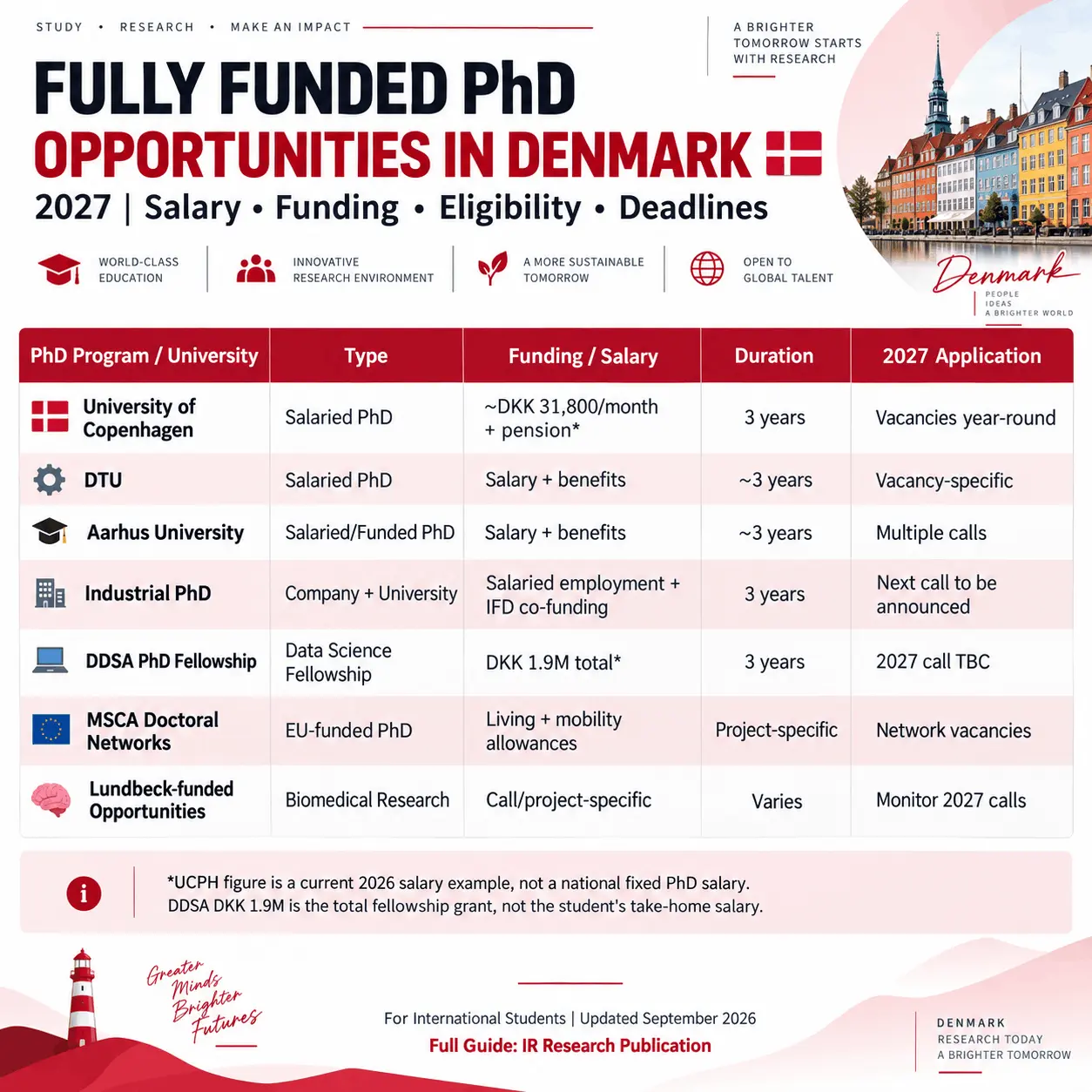
    At-a-Glance: Salaried PhD Positions at Danish Universities

    University / ProgramTypical EligibilityFunding ModelApplication TimelineOfficial Link
    University of Copenhagen PhD PositionsRelevant master’s or equivalent; project/faculty-specific requirementsSalaried PhD employment; pension and benefits under applicable agreementVacancies throughout the yearUCPH PhD Vacancies
    DTU PhD PositionsRelevant master’s; strong fit with technical/research projectPhD employment with salary and benefits according to applicable termsVacancy-specificDTU PhD
    Aarhus University PhD PositionsMaster’s or applicable integrated route; graduate-school-specific requirementsFunded PhD employment or fellowship depending on faculty/callGraduate-school rounds and individual vacanciesAarhus University PhD
    University of Southern Denmark PhD PositionsRelevant master’s/equivalent; faculty-specific eligibilitySalaried PhD positions where advertisedThroughout the yearSDU PhD
    Aalborg University PhD PositionsRelevant master’s and research/project fitSalaried doctoral employment for funded positionsVacancy-specificAAU PhD
    Copenhagen Business School PhD PositionsRelevant master’s; strong academic record; proposal where requiredSalaried PhD scholarship/employmentFaculty and project-specific callsCBS PhD
    Roskilde University PhD PositionsMaster’s/equivalent; project and interdisciplinary fitFunded PhD employment depending on vacancyCalls throughout yearRUC PhD
    IT University of Copenhagen PhD PositionsRelevant master’s; computing, digital, design or information-related fitSalaried PhD employment where advertisedVacancy/call-specificITU PhD Programme

    Competitive National and International PhD Funding Routes

    ProgramMain Eligibility / ModelCurrent Verified Funding2027 StatusOfficial Link
    Innovation Fund Denmark – Industrial PhDMaster’s; company/public organization + university + candidate partnership; current grade requirements applyUp to DKK 17,000/month salary subsidy + up to DKK 100,000 travel/course costs + DKK 360,000 to universityAutumn 2026 round closed September 8; monitor next callsIndustrial Researcher Programme
    Danish Data Science Academy PhD FellowshipCandidate eligible for Danish PhD; own data-science project + Danish supervisor/host2026 call: DKK 1.9M over 3 years + 5% administrative costs2026 call closed March 4; 2027 call not yet confirmedDDSA Fellowship
    MSCA Doctoral NetworksMust not already hold PhD; any nationality; mobility rule; recruited by funded networkEU living + mobility + eligible family/leave/special-needs allowances2026 consortium call closes Nov. 24; individual PhD vacancies appear laterMSCA Doctoral Networks
    Lundbeck Foundation-supported PhD OpportunitiesDepends on specific biomedical/neuroscience funding callCall-specificNo single generic 2027 PhD fellowship should be assumed; monitor current grant portfolioLundbeck Foundation Grants

    Important: Grant totals, university funding and salary subsidies are not necessarily equivalent to the researcher’s gross salary or take-home pay.


    How Much Do PhD Students Earn in Denmark?

    There is no single fixed national PhD salary that applies identically to every researcher.

    Salary depends on factors including:

    • university;
    • applicable collective agreement;
    • prior relevant experience;
    • faculty or department;
    • type of appointment;
    • supplements;
    • funding arrangement.

    University of Copenhagen Salary Example

    As a current reference point, a University of Copenhagen PhD vacancy at the Faculty of Science in August 2026 listed a starting salary of approximately:

    DKK 31,800 per month before tax

    plus an additional:

    18.07% employer-paid pension contribution

    Depending on qualifications and the specific employment agreement, supplements may also apply.

    This should be treated as a University of Copenhagen example, not as a fixed nationwide Danish PhD salary.

    Other UCPH faculties and Danish universities may use somewhat different salary steps or arrangements.


    Current Verified Funding Examples

    OpportunityCurrent Verified Funding Example
    University of Copenhagen PhDApproximately DKK 31,800/month before tax in a current SCIENCE vacancy + 18.07% employer-paid pension
    DDSA PhD Fellowship 2026DKK 1.9 million over 3 years + 5% administrative costs
    Industrial PhDUp to DKK 17,000/month salary subsidy + up to DKK 100,000 travel/course support + DKK 360,000 to university
    MSCA Doctoral NetworksLiving allowance + mobility allowance + eligible family, long-term-leave and special-needs allowances

    These amounts use different funding models and should not be compared as if they were personal annual salaries.


    1. University of Copenhagen PhD Fellowships

    Overview

    The University of Copenhagen (UCPH) is Denmark’s largest university and offers doctoral research across:

    • health and medical sciences;
    • natural and life sciences;
    • humanities;
    • law;
    • social sciences;
    • theology.

    The university advertises numerous PhD fellowships throughout the year.

    Employment and Funding

    Standard funded positions are commonly offered as fixed-term employment.

    Current university vacancies state that salary, pension and employment conditions are governed by agreements between the relevant Danish authorities and academic professional organizations.

    Depending on the faculty and position, PhD fellows may receive:

    • monthly salary;
    • employer-paid pension;
    • paid annual leave;
    • employee protections;
    • research training;
    • PhD coursework;
    • international research stays;
    • access to university research infrastructure.

    Eligibility

    Requirements vary by faculty, but applicants generally need a qualification equivalent to a relevant Danish master’s degree for a standard three-year PhD route.

    Some faculties also operate integrated master’s/PhD structures.

    Application

    There is no single UCPH annual PhD deadline.

    Candidates apply directly to advertised vacancies.

    View University of Copenhagen PhD positions


    2. Technical University of Denmark (DTU) PhD Positions

    Overview

    The Technical University of Denmark (DTU) is a major European technical university with PhD opportunities in areas such as:

    • engineering;
    • biotechnology;
    • computer science;
    • artificial intelligence;
    • chemistry;
    • physics;
    • energy;
    • sustainability;
    • transport;
    • food science;
    • environmental engineering;
    • space research;
    • life science.

    Funding

    Funded DTU doctoral positions generally involve employment under the terms specified in the vacancy and relevant Danish employment framework.

    Eligibility

    Applicants normally need a relevant master’s-level qualification or equivalent academic preparation.

    Technical knowledge, research experience and specific methodological skills are determined by the project.

    Application

    PhD positions are advertised individually.

    DTU PhD Education


    3. Aarhus University PhD Fellowships

    Overview

    Aarhus University (AU) offers PhD education across several graduate-school environments spanning:

    • Arts;
    • Health;
    • Natural Sciences;
    • Technical Sciences;
    • Aarhus BSS.

    Recruitment structures differ across faculties.

    Some opportunities are tied to predefined funded projects, while others are offered through graduate-school application rounds.

    Funding and Employment

    Funding arrangements depend on the specific call, but fully funded doctoral appointments commonly provide salary and employment benefits.

    Application

    Always apply through the relevant AU graduate school or vacancy portal rather than assuming a university-wide deadline.

    Aarhus University PhD Studies


    4. University of Southern Denmark PhD Positions

    The University of Southern Denmark (SDU) offers doctoral research across:

    • engineering;
    • health sciences;
    • science;
    • humanities;
    • business;
    • social sciences.

    Many positions are linked to research grants and individual projects.

    Requirements and deadlines therefore differ considerably between faculties.

    SDU PhD Programmes


    5. Aalborg University PhD Positions

    Aalborg University (AAU) is well known for interdisciplinary and problem-oriented research and for collaboration with industry and public-sector organizations.

    Research strengths include:

    • engineering;
    • energy;
    • digital technologies;
    • health;
    • social sciences;
    • sustainability;
    • communication and IT.

    Funded positions are advertised individually, with eligibility and employment terms stated in each vacancy.

    Aalborg University PhD Studies


    6. Copenhagen Business School PhD Scholarships

    The term “PhD scholarship” is commonly used at Copenhagen Business School (CBS), but funded positions are typically structured within Denmark’s doctoral employment and training system rather than functioning like a conventional tuition scholarship.

    Research areas include:

    • economics;
    • finance;
    • management;
    • organization;
    • strategy;
    • marketing;
    • entrepreneurship;
    • digitalization;
    • business and society.

    Applicants may need a detailed research proposal depending on the call.

    CBS PhD


    7. Roskilde University PhD Positions

    Roskilde University (RUC) emphasizes interdisciplinary and problem-oriented research.

    Doctoral opportunities span areas such as:

    • social sciences;
    • humanities;
    • communication;
    • environmental science;
    • natural science.

    PhD opportunities are advertised according to available funded projects and institutional calls.

    Roskilde University PhD


    8. IT University of Copenhagen PhD Programme

    The IT University of Copenhagen (ITU) specializes in digital research, including:

    • computer science;
    • artificial intelligence;
    • software;
    • algorithms;
    • data science;
    • human-computer interaction;
    • digital design;
    • information studies;
    • digital society.

    Funded PhD positions are normally advertised around defined research areas or projects.

    ITU PhD Programme


    9. Innovation Fund Denmark Industrial PhD

    The Industrial PhD is one of Denmark’s most distinctive doctoral funding routes.

    It combines doctoral research with employment in a private company or public organization.

    A typical Industrial PhD involves:

    1. an Industrial PhD candidate;
    2. a company or public organization;
    3. a university.

    The project normally lasts three years.

    Who Employs the PhD Candidate?

    The company or public organization employs the PhD candidate.

    Innovation Fund Denmark provides co-financing—it does not simply replace the employer or pay the candidate’s entire salary directly.

    Current Funding

    Under the current Industrial Researcher framework, Innovation Fund Denmark can contribute:

    • up to DKK 17,000 per month toward the candidate’s salary;
    • up to DKK 100,000 toward travel and course participation;
    • a fixed DKK 360,000 including overhead to the university.

    The employer remains responsible for the employment relationship and salary.

    Important Eligibility Requirements

    The candidate normally needs a master’s degree or equivalent.

    Current 2026 Industrial PhD requirements for Danish-equivalent grading include:

    • at least 10 for the master’s thesis/final project; and
    • either a weighted average of at least 8.2 across bachelor’s and master’s studies;
    • or at least 9.5 for a two-year master’s degree alone.

    These figures use the Danish 7-point grading scale.

    Rules exist for foreign qualifications and possible exemptions, so international applicants should consult the current Industrial PhD guidelines rather than trying to convert grades themselves.

    Current Application Status

    The autumn 2026 round:

    • opened August 4, 2026;
    • closed September 8, 2026 at 12:00.

    Applicants targeting a 2027 project should monitor Innovation Fund Denmark for the next Industrial Researcher calls.

    Innovation Fund Denmark – Industrial Researcher


    10. Danish Data Science Academy PhD Fellowships

    The Danish Data Science Academy (DDSA) is particularly attractive for researchers interested in:

    • data science;
    • machine learning;
    • artificial intelligence;
    • statistics;
    • computational science;
    • bioinformatics;
    • data-driven research applications.

    2026 Fellowship Funding

    The latest DDSA PhD Fellowship Call offered:

    10 three-year PhD fellowships

    worth:

    DKK 1.9 million each

    plus:

    5% administrative costs

    The total fellowship is intended to contribute to expenses such as salary, tuition, external research stays, travel and relevant operational costs.

    The DKK 1.9 million therefore should not be interpreted as the student’s personal salary.

    If the total PhD project cost exceeds the fellowship amount, the host institution is expected to cover the additional costs.

    Eligibility

    Applicants must be eligible for admission to a Danish PhD programme.

    The 2026 call accepted candidates under Danish structures including:

    • 3+5;
    • 4+4;
    • 5+3 models.

    Applicants needed:

    • their own defined research project;
    • an agreement with a principal supervisor at a Danish university;
    • a project within theoretical or applied data science aligned with the DDSA funding scope.

    Current Status

    The 2026 call closed:

    March 4, 2026 at 23:59 CET.

    A 2027 fellowship call has not yet been confirmed, so applicants should monitor DDSA rather than assuming the same deadline or amount will automatically apply next year.

    DDSA PhD Fellowship Call


    11. Marie Skłodowska-Curie Doctoral Networks in Denmark

    Marie Skłodowska-Curie Actions (MSCA) Doctoral Networks fund international doctoral-training consortia across Europe.

    Danish universities, research institutes, companies and other organizations can participate as recruiting hosts.

    Important Eligibility Rules for PhD Candidates

    Candidates recruited by an MSCA Doctoral Network:

    • must not already hold a doctoral degree at the date of recruitment;
    • can be of any nationality;
    • must be enrolled in a doctoral programme during the project;
    • must comply with the MSCA mobility rule.

    The standard mobility rule means that the candidate normally must not have resided or carried out their main activity in Denmark for more than 12 months during the 36 months immediately before recruitment if the recruiting organization is in Denmark.

    Funding

    MSCA support for recruited doctoral candidates can include:

    • living allowance;
    • mobility allowance;
    • family allowance where applicable;
    • long-term-leave support where applicable;
    • special-needs allowance where applicable.

    Funding is also provided to the participating institutions for research, training, networking, management and indirect costs.

    Important: Candidates Do Not Apply to the Consortium Call

    The 2026 MSCA Doctoral Networks call closes November 24, 2026, but that deadline is for universities, research institutions, companies and other organizations creating the Doctoral Networks.

    It is not a direct PhD-student application deadline.

    After networks receive funding, the individual doctoral vacancies are advertised internationally, including through EURAXESS and participating institutions.

    Candidates then apply to the individual PhD vacancies.

    MSCA Doctoral Networks

    EURAXESS Research Jobs


    12. Lundbeck Foundation-Supported PhD Opportunities

    The Lundbeck Foundation is a major Danish research funder, particularly in biomedical and health-related research.

    However, applicants should be cautious with generic online lists describing a permanent annual “Lundbeck Foundation PhD Fellowship.”

    The Foundation operates multiple funding programs, and the availability, eligibility and structure of PhD support depend on the specific current grant call.

    Therefore, rather than assuming a standard annual 2027 PhD fellowship, applicants should monitor the Foundation’s official grants portfolio for relevant:

    • biomedical research grants;
    • neuroscience opportunities;
    • investigator-led projects that may recruit PhD students;
    • call-specific early-career or education funding.

    Lundbeck Foundation Grants


    How Long Is a PhD in Denmark?

    A standard Danish PhD following a completed master’s degree typically corresponds to approximately three years of full-time doctoral study.

    However, Denmark also has integrated pathways in which students begin doctoral training before completing the master’s degree.

    Terms such as:

    • 5+3
    • 4+4
    • 3+5

    refer to different points at which the researcher enters the overall university/doctoral education pathway.

    The exact structure varies by university and graduate school.


    Do PhD Students Pay Tuition in Denmark?

    For standard fully funded doctoral positions, the candidate generally does not personally pay conventional tuition in the same way as an unfunded bachelor’s or master’s student.

    There are nevertheless real tuition and institutional education costs associated with doctoral enrollment.

    Depending on the funding model, these costs may be paid by:

    • the host university;
    • the research grant;
    • an external fellowship;
    • the company/university arrangement;
    • the doctoral network.

    This is why “tuition covered” is more accurate than claiming doctoral training has no institutional costs at all.


    Can International Students Apply for PhDs in Denmark?

    Yes.

    Danish universities regularly recruit researchers internationally, and many PhD vacancies are advertised in English.

    Selection normally focuses on:

    • academic qualifications;
    • research experience;
    • project fit;
    • technical or methodological expertise;
    • master’s thesis quality;
    • language requirements;
    • the specific eligibility criteria of the position.

    Non-EU/EEA applicants will also need the appropriate Danish residence and work authorization after receiving an eligible offer.


    Is Danish Language Required?

    For many laboratory, engineering, data-science and internationally oriented research positions, English is sufficient.

    However, Danish may be required or strongly preferred for projects involving:

    • clinical patient interaction;
    • Danish schools;
    • public-sector research;
    • qualitative interviews conducted in Danish;
    • Danish-language archives or datasets;
    • teaching or outreach requiring Danish.

    Always check the individual vacancy.


    Where to Find PhD Positions in Denmark

    Because many Danish doctoral opportunities are advertised like jobs, candidates should monitor university vacancy pages regularly rather than waiting for one annual scholarship cycle.

    Strong starting points include:

    • University of Copenhagen
    • DTU
    • Aarhus University
    • SDU
    • Aalborg University
    • Copenhagen Business School
    • Roskilde University
    • IT University of Copenhagen
    • EURAXESS

    IR Research Publication also maintains a regularly updated research jobs page covering PhD, postdoc and faculty opportunities.

    For a broader funding strategy, see our PhD Scholarship Guide: How to Find, Win, and Fund a Fully Funded PhD.


    How to Make Your Denmark PhD Application Competitive

    1. Treat the Application Like a Research Job Application

    For project-specific vacancies, your application should explain exactly how your background fits the proposed research.

    Avoid sending the same generic statement to every university.

    2. Match Your Skills to the Project

    Highlight relevant:

    • research methods;
    • laboratory techniques;
    • statistical expertise;
    • programming languages;
    • datasets;
    • master’s-thesis experience;
    • publications;
    • internships;
    • industry experience.

    3. Read the Research Group’s Recent Work

    Before applying, review recent publications from:

    • the principal investigator;
    • the department;
    • the specific research center.

    This will strengthen both your motivation letter and interview preparation.

    4. Prepare a Strong Research Proposal When Required

    Some opportunities—particularly candidate-driven fellowships and Industrial PhD applications—require a substantial proposal.

    A strong research plan should explain:

    • the research problem;
    • knowledge gap;
    • hypothesis or research question;
    • methodology;
    • feasibility;
    • timeline;
    • expected outcomes;
    • risks and alternatives;
    • scientific or societal significance.

    5. Contact Supervisors Early for Candidate-Driven Funding

    Supervisor contact is particularly important for:

    • DDSA;
    • Industrial PhD;
    • candidate-driven graduate-school applications;
    • external foundation opportunities.

    By contrast, for an advertised project-defined PhD job, follow the vacancy instructions before sending unsolicited materials.

    6. Check Funding Before Accepting an Offer

    Determine whether the position provides:

    • an employment contract;
    • pension;
    • salary;
    • tuition coverage;
    • relocation support;
    • travel support;
    • health/social benefits;
    • teaching obligations.

    Do not assume every “scholarship” has the same legal or financial structure.


    Documents Commonly Required for a Denmark PhD Application

    Depending on the university and program, applicants may need:

    • academic CV;
    • motivation or cover letter;
    • bachelor’s transcript;
    • master’s transcript;
    • degree certificates;
    • master’s thesis;
    • research proposal;
    • publication list;
    • writing samples;
    • recommendation letters or referee details;
    • proof of English proficiency;
    • documentation of relevant technical skills.

    Industrial PhD and candidate-driven fellowship applications can require additional project, supervisor and host-organization documentation.


    When Should You Apply for a 2027 PhD in Denmark?

    September–December 2026

    This is an excellent period to:

    • monitor Danish university vacancy portals;
    • apply to project-funded positions with 2027 start dates;
    • identify prospective supervisors;
    • prepare transcripts and references;
    • monitor new national funding calls;
    • follow MSCA Doctoral Network projects and future recruitment.

    January–June 2027

    Continue checking:

    • university job portals;
    • Innovation Fund Denmark;
    • DDSA;
    • EURAXESS;
    • Danish foundations;
    • newly funded EU networks.

    Throughout 2027

    New vacancies can appear at any time because Danish PhD recruitment is often tied to the start of individual funded projects rather than one national admission cycle.


    Frequently Asked Questions

    Are PhD positions in Denmark fully funded?

    Many advertised Danish PhD positions are fully funded through salaried university employment.

    Other doctoral routes may use external fellowships, company employment, EU funding or other grant structures.

    Always confirm the funding model in the individual call.


    Is a PhD in Denmark a job?

    Many standard Danish PhD positions function as fixed-term employment combined with doctoral education.

    The researcher carries out an original research project while completing doctoral training requirements.


    What is the PhD salary in Denmark?

    There is no single national figure that applies identically to every appointment.

    As one current example, a 2026 University of Copenhagen PhD vacancy lists a starting salary of approximately DKK 31,800 per month before tax, with an additional 18.07% employer-paid pension contribution.

    Exact salary varies by employer, experience, agreement and appointment.


    How long is a PhD in Denmark?

    A standard PhD following a completed master’s degree is normally approximately three years full-time.

    Integrated master’s/PhD pathways can have longer overall structures.


    Do I need a master’s degree?

    For a standard 5+3-style doctoral route, applicants generally need a relevant master’s-level qualification.

    Some universities also offer integrated structures allowing researchers to begin PhD training earlier in their master’s education.


    Can Indian students apply for fully funded PhDs in Denmark?

    Yes.

    Indian and other international applicants can apply to many Danish university PhD vacancies provided they meet the academic and project-specific requirements.

    Industrial PhD, DDSA and MSCA opportunities have additional scheme-specific eligibility conditions.


    Can I apply for MSCA Doctoral Networks if I already have a PhD?

    No.

    Researchers recruited as doctoral candidates under MSCA Doctoral Networks must not already hold a doctoral degree at the date of recruitment.


    How does the MSCA mobility rule work?

    For a Danish host, applicants generally must not have lived, worked or carried out their main activity in Denmark for more than 12 months during the 36 months immediately before recruitment.

    Specific exceptions in MSCA rules should always be checked.


    Is the November 24, 2026 MSCA Doctoral Networks deadline for PhD students?

    No.

    That is the deadline for consortia submitting proposals to establish Doctoral Networks.

    Prospective PhD candidates apply later to individual positions advertised by funded networks.


    How much does the Industrial PhD pay?

    The student’s actual salary is paid by the employing company or public organization.

    Innovation Fund Denmark currently provides co-financing, including up to DKK 17,000 per month toward salary costs, rather than setting the candidate’s total salary at DKK 17,000.


    Is the DDSA DKK 1.9 million fellowship the student’s salary?

    No.

    The DKK 1.9 million is the three-year fellowship grant amount, intended to cover several project costs including salary, tuition, research stay, travel and operational expenses.

    It is not equivalent to personal take-home income.


    Do I need Danish?

    Usually not for many internationally recruited STEM and research positions, but specific clinical, educational, public-facing or Danish-language projects may require it.


    Final Application Checklist

    Before submitting a Denmark PhD application, confirm:

    • I meet the degree requirements.
    • I meet the project’s specific academic criteria.
    • My CV is tailored to the vacancy.
    • My motivation letter explains research fit.
    • I understand whether a research proposal is required.
    • I have checked the funding model.
    • I know whether I will be an employee or fellowship recipient.
    • I have confirmed salary and pension arrangements.
    • Tuition or enrollment costs are covered.
    • My transcripts and degree certificates are ready.
    • My referees are prepared.
    • I meet the English-language requirements.
    • I meet any mobility rules.
    • I have verified the exact deadline and time zone.
    • I have checked the official webpage immediately before submission.

    Conclusion: Fully Funded PhD Scholarships in Denmark 2027

    Denmark offers an excellent environment for international researchers seeking fully funded PhD scholarships in Denmark for 2027, but the Danish funding model is different from the traditional scholarship systems used in many countries.

    At major universities such as the University of Copenhagen, DTU, Aarhus University, SDU, Aalborg University, CBS, Roskilde University and IT University of Copenhagen, many doctoral opportunities are advertised as salaried research positions.

    Additional competitive routes include the Innovation Fund Denmark Industrial PhD, the Danish Data Science Academy PhD Fellowship, and Marie Skłodowska-Curie Doctoral Networks involving Danish research institutions.

    Applicants should remember that there is no single national 2027 deadline. Positions will continue to appear from late 2026 throughout 2027.

    The strongest strategy is to begin monitoring vacancies early, understand the difference between salary and grant funding, tailor every application to the specific research project, and verify eligibility directly from the official call before applying.

    For additional opportunities and application guidance, explore the IR Research Publication PhD Scholarship Guide and our latest PhD, postdoctoral and faculty research opportunities.


    Related Articles


    About IR Research Publication

    IR Research Publication is a research and academic-career platform supporting students, researchers and scholars with practical guidance on PhD funding, postdoctoral fellowships, academic careers, scientific publishing and research development.

    Our funding guides are designed to help researchers identify credible opportunities while emphasizing the importance of confirming eligibility, salaries, funding structures and deadlines directly from official sources.

    Visit IR Research Publication


    Last reviewed: September 12, 2026

    Disclaimer: Salary levels, pension rates, funding amounts, eligibility requirements and deadlines may change between calls. Always verify the latest information on the official university or funder’s website before applying.
  • How to Find Fully Funded PhD Positions in Europe (2026)

    How to Find Fully Funded PhD Positions in Europe (2026)

    Introduction: Why This Guide Matters

    Fully funded PhD positions in Europe offer an exceptional route to develop as a researcher without incurring heavy tuition costs. In many European countries, doctoral candidates are contracted employees with social benefits, while in others, scholarships and stipends cover living expenses and fees. This guide is written for master’s students, graduating seniors, industry professionals switching to research, and postgraduates seeking international doctoral training.

    Common mistakes include applying to the wrong type of funding, missing mobility rules (e.g., MSCA), sending generic emails to supervisors, and underestimating the time needed to prepare documents. Here you’ll learn how to target the right opportunities, make your profile competitive, and confidently navigate applications, interviews, and relocation.

    We provide evidence-based advice, real examples, official resources, and templates you can use immediately to improve your success rate in 2026 application cycles and beyond.

    Fully Funded PhD Scholarships in France 2027 | Apply Now

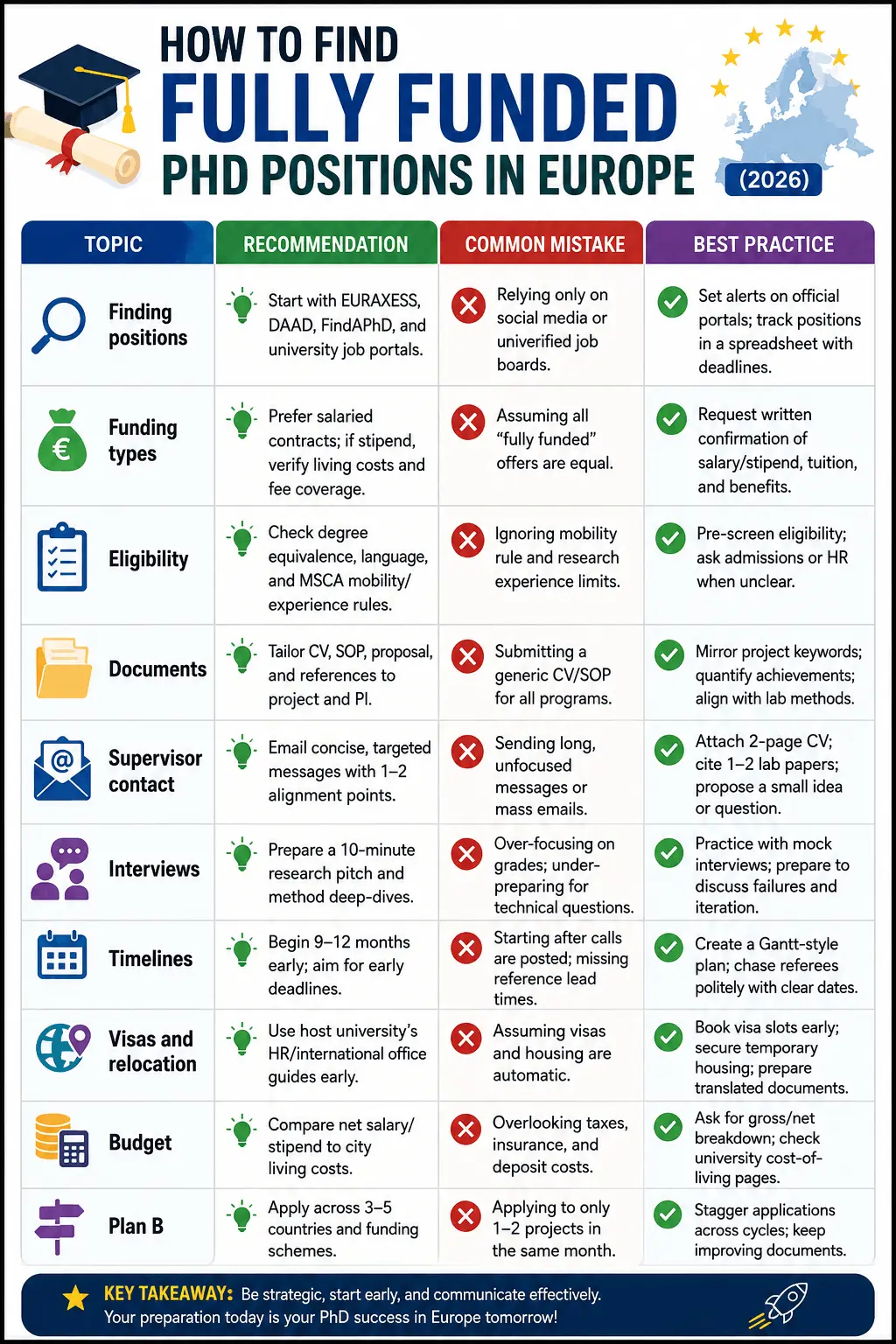
    Quick Summary Table: How to Find Fully Funded PhD Positions in Europe (2026)

    TopicRecommendationCommon MistakeBest Practice
    Finding positionsStart with EURAXESS, DAAD, FindAPhD, and university job portals.Relying only on social media or unverified job boards.Set alerts on official portals; track positions in a spreadsheet with deadlines.
    Funding typesPrefer salaried contracts; if stipend, verify living costs and fee coverage.Assuming all “fully funded” offers are equal.Request written confirmation of salary/stipend, tuition, and benefits.
    EligibilityCheck degree equivalence, language, and MSCA mobility/experience rules.Ignoring mobility rule and research experience limits.Pre-screen eligibility; ask admissions or HR when unclear.
    DocumentsTailor CV, SOP, proposal, and references to project and PI.Submitting a generic CV/SOP for all programs.Mirror project keywords; quantify achievements; align with lab methods.
    Supervisor contactEmail concise, targeted messages with 1–2 alignment points.Sending long, unfocused messages or mass emails.Attach 2-page CV; cite 1–2 lab papers; propose a small idea or question.
    InterviewsPrepare a 10-minute research pitch and method deep-dives.Over-focusing on grades; under-preparing for technical questions.Practice with mock interviews; prepare to discuss failures and iteration.
    TimelinesBegin 9–12 months early; aim for early deadlines.Starting after calls are posted; missing reference lead times.Create a Gantt-style plan; chase referees politely with clear dates.
    Visas and relocationUse host university’s HR/international office guides early.Assuming visas and housing are automatic.Book visa slots early; secure temporary housing; prepare translated documents.
    BudgetCompare net salary/stipend to city living costs.Overlooking taxes, insurance, and deposit costs.Ask for gross/net breakdown; check university cost-of-living pages.
    Plan BApply across 3–5 countries and funding schemes.Applying to only 1–2 projects in the same month.Stagger applications across cycles; keep improving documents.

    What “Fully Funded PhD Positions in Europe” Means

    In Europe, “fully funded” typically means your tuition/fees are covered and you receive a monthly salary or stipend sufficient to live modestly in the host city. There are two common models:

    Australia vs New Zealand for PhD: Costs, Visas, Jobs

    • Salaried employment (most common in Northern/Western Europe): You are hired as an employee (e.g., PhD candidate/doctoral researcher) with a contract, salary, and benefits (social insurance, pension, paid leave). Examples: Netherlands, Sweden, Denmark, Norway, Finland, Germany (often 50–100% TV-L E13), Switzerland, Belgium, and many MSCA Doctoral Networks.
    • Scholarship or stipend model: You receive a monthly allowance and fee waiver. Common in some programs in France (contrat doctoral is employment; some schools use stipends), Italy, Spain (FPI/FPU contracts are employment; other schemes may be stipends), Portugal (FCT fellowships), Central/Eastern Europe, and certain UK studentships (stipend plus fee coverage).

    Always request written details: salary or stipend amount, indexation over years, fee coverage, insurance, parental leave, teaching loads, and contract duration (usually 3–4 years, up to 5–6 in some countries including the Netherlands or part-time arrangements).

    Where to Find Fully Funded PhD Positions in Europe (Top Portals)

    • EURAXESS Jobs – The EU’s official portal for research jobs and fellowships across Europe. Filter by “PhD Candidate” or “Recognised Researcher,” field, country, and funding.
    • FindAPhD – Comprehensive listings of funded and competition-based PhD positions, especially UK, Ireland, Benelux, DACH, Nordics, and EU networks.
    • DAAD Scholarship Database – Official funding for studies and research in Germany, including structured doctoral programs, research grants, and graduate schools.
    • MSCA Doctoral Networks (DNs) – EU-funded networks recruiting international doctoral candidates. Check network websites or EURAXESS for open positions. Note the mobility rule and early-stage researcher criteria.
    • Nature Careers – Research jobs across Europe, including many top labs and institutes.
    • Academic Positions – Aggregated research and academic vacancies across Europe; filter by “PhD” level.
    • THE UniJobs – Academic jobs including doctoral candidateships, especially in the UK and EU.
    • University portals – Always check the “Jobs,” “Doctoral School,” or “Graduate School” pages of target universities and institutes (e.g., Max Planck, EMBL, ETH Domain).

    Funding Models by Country (2026 Snapshot)

    Funding structures vary significantly. Below is a practical overview (always verify current terms on official pages):

    • Germany: Many PhD candidates are employed on TV-L E13 contracts at 50–100% (part-time or full-time), especially in DFG-funded projects and graduate schools. Others hold DAAD or external scholarships. Fees are generally minimal (semester contributions). See DFG funding and DAAD.
    • Netherlands: PhD candidates are university employees with salaries following national scales (e.g., UFO Scale P). Typical 4-year contracts with annual progression and no tuition fees. See a typical vacancy on AcademicTransfer.
    • Sweden: PhD students are employees with monthly salaries and benefits; tuition fees are generally not charged for doctoral education. See Studera.nu and university HR pages.
    • Denmark: PhD fellows are employees under collective agreements, with salary and pension. Check host universities (e.g., University of Copenhagen PhD).
    • Norway: PhD candidates are employees with full salaries; doctoral education has no tuition fees for employees. See JobbNorge and university HR portals.
    • Finland: Doctoral researchers are often employed, sometimes with mixed funding (projects + grants). Many universities offer salaried Doctoral Researcher posts.
    • France: Doctoral candidates often hold a contrat doctoral (employment) or other funded arrangements. Tuition is modest compared to many countries. See Campus France.
    • Switzerland: PhD candidates are usually employed by universities or institutes (ETH/EPFL/Universities/CERN affiliations), with competitive salaries. See ETH Doctorate and EPFL Doctorate.
    • Belgium: Funding through employment (e.g., doctoral assistant) or scholarships (FWO/FNRS). See FWO and FNRS.
    • Austria: Mixture of employment contracts and stipends; most doctoral candidates in funded projects are employees. See FWF.
    • Ireland: Funded studentships via SFI Centres, IRC (Irish Research Council), and industry co-funding; often stipend + fee coverage. See Irish Research Council and SFI.
    • Spain: Many fully funded via employment contracts (FPI/FPU), others via scholarships. See Agencia Estatal de Investigación.
    • Portugal: FCT fellowships and contracts fund many PhDs; verify fee waivers and insurance. See FCT.
    • Italy: PhD scholarships are common; amounts and fee waivers vary by university and region. See individual university doctoral schools.
    • United Kingdom: UK remains a top destination in Europe with “studentships” (stipend + fee coverage). Check FindAPhD, Jobs.ac.uk, DTP/CDT websites, and university portals.

    Step 1: Define Your Fit and Research Direction

    Before searching, crystalize your research identity and constraints:

    • Field and subfield (e.g., machine learning for healthcare NLP; molecular immunology; sustainable catalysis).
    • Methods you bring (e.g., RCT design, single-cell RNA-seq, finite element modeling).
    • Outputs that prove readiness (thesis, preprints, code repositories, internships, conference posters).
    • Constraints (start date, family, location preferences, language, visa requirements).

    Create a one-page “profile brief” to guide your search and outreach.

    Step 2: Learn Eligibility and Rules That Can Disqualify You

    • Degree requirements: Most programs require a master’s (or 4–5-year integrated degree). Some allow direct PhD entry from bachelor’s in STEM with exceptional records (e.g., Netherlands, UK, select Germany tracks).
    • Language: English suffices for most STEM PhDs. For programs taught in local languages, check DSH/TestDaF (Germany), TCF/DELF-DALF (France), etc.
    • MSCA Doctoral Networks: You must have less than 4 years of full-time equivalent research experience and not have lived/studied in the host country for more than 12 months in the last 36 months before recruitment.
    • Work status: For employee-based PhDs, you must meet employment and visa rules; for scholarship-based, check residency/taxation impacts.
    • GRE/GMAT: Rarely required in Europe; verify for specific schools.

    Highest-Paying Postdoctoral Fellowships Worldwide (2026)

    Step 3: Source Positions Systematically

    1. Set alerts on EURAXESS, FindAPhD, Academic Positions, and Nature Careers.
    2. List target universities and institutes; subscribe to their vacancy newsletters.
    3. Track deadlines in a spreadsheet: portal, project title, PI, requirements, documents, referee status, and submission URL.
    4. Check MSCA DN consortium pages for each network you’re interested in; positions may be posted on multiple partner sites.

    Step 4: Shortlist by Funding Security and Fit

    Consider:

    • Contract vs stipend: Employment contracts generally offer higher stability and benefits.
    • Fee policy: Ensure full fee waiver for international students if not an employee.
    • Cost-of-living match: Compare monthly net income to local living expenses using university guides.
    • Supervisor track record: Review recent publications, completed PhD supervisions, funding stability, and alumni outcomes.

    USA vs Canada for PhD: Best Choice for Indian Students in 2026

    Step 5: Prepare Core Documents that Win Interviews

    • Academic CV (2–3 pages): Results-focused, with quantifiable outputs.
    • Statement of Purpose/Motivation (1–2 pages): Your research trajectory, fit, and why this lab/program now.
    • Research Proposal (2–5 pages if requested): For open-topic programs or scholarships; project-defined roles need a targeted idea sketch.
    • References: 2–3 academic/industry referees who can attest to your research ability and independence.
    • Transcripts and certificates: Official or certified copies with English translations if needed.
    • Language proof: IELTS/TOEFL or local tests where required; ask about waivers if you studied in English.

    Sample Email to a Potential Supervisor (Cold Outreach)

    Subject: Prospective PhD applicant for [Project/Area] — alignment with your recent work on [Keyword]

    Dear Dr./Prof. [Surname],

    I am a [your degree and institution, graduation year], focusing on [your methods/area]. Your recent paper on [title or keyword, year/journal] aligns closely with my master’s thesis on [topic], where I [1–2 quantified results, e.g., developed a [model/method] that improved [metric] by X%].

    I noticed your group is working on [specific project or call; include link/reference ID if applicable]. I would be keen to contribute to [specific aim or method], particularly [concrete idea or question]. I have attached a 2-page CV and a short summary of my thesis.

    Would it be possible to schedule a 15-minute call to discuss potential PhD openings or whether my profile would be competitive for [program/grant, e.g., MSCA DN “NAME”]?

    Thank you for your time and consideration.

    Kind regards,
    [Full Name] | [Current role]
    [Institution] | [City, Country]
    [Email] | [LinkedIn/Website/ORCID/GitHub]

    Academic CV Example (Structure)

    • Header: Name, email, website/ORCID, location.
    • Research Interests: 3–5 bullet points with methods and application domains.
    • Education: Degrees with thesis title, advisors, GPA (if strong), dates.
    • Publications: Peer-reviewed, preprints, conference abstracts; provide DOIs/links.
    • Research Experience: Projects, role, outcomes (data/code/papers), tools used.
    • Teaching/Leadership: TA roles, workshops, mentoring.
    • Awards/Grants: Scholarships, travel grants, distinctions.
    • Skills: Methods, programming, instruments, languages (CEFR levels).

    SOP/Motivation Letter Outline

    1. Opening hook: Your research problem and why it matters.
    2. Background: 2–3 achievements showing readiness (quantify impact).
    3. Fit: Why this PI/program/network; cite 1–2 recent papers or facilities.
    4. Future project: A brief, feasible idea aligned with the call.
    5. Training plan: Methods you will learn; collaborations/secondments.
    6. Closing: Career aims and contribution to the host’s mission.

    Research Proposal Skeleton (If Requested)

    1. Title and Keywords
    2. Problem Statement and Significance
    3. State of the Art (with 5–10 key references)
    4. Research Questions/Hypotheses
    5. Methodology (datasets, instruments, analysis plan; risks and mitigation)
    6. Work Plan and Timeline (Gantt blocks: WP1–WP4)
    7. Expected Outcomes (papers, code, prototypes, policy impact)
    8. Ethics and Data Management (GDPR, open data/code plan)
    9. References (consistent citation style)

    Cover Letter Template for an Advertised PhD Post

    Dear Hiring Committee/Dr. [Surname],

    I am applying for the PhD position “[Title/Ref]” at [University/Institute]. My background in [methods/field] and my thesis on [topic] position me to contribute immediately to [project objective]. In my recent project, I [key accomplishment with metric].

    I am particularly drawn to your lab’s work on [cite 1–2 papers/facilities] and the opportunity to [training/secondment if MSCA/industry link]. I have attached my CV, transcripts, and a brief proposal aligned with [work package or aim].

    Thank you for considering my application. I look forward to the possibility of discussing how I can support [group/program] in achieving [goal].

    Sincerely,
    [Full Name]

    Typical Interview Questions

    • Explain your thesis contribution in 3–5 minutes. What was novel?
    • Walk us through a failed experiment and what you changed.
    • Which methods will you need to learn for this project, and how?
    • How would you design an experiment to test [project-specific hypothesis]?
    • How do you plan your time and manage multiple deadlines?
    • What do you expect from supervision, and how do you handle feedback?

    Step 6: Apply with Precision

    • Match every eligibility criterion and keyword from the advert.
    • Upload documents in the requested order and format; name files consistently (Lastname_Firstname_DocType.pdf).
    • Get references early. Provide your referees a one-page brief with deadlines, advert link, and your highlights.
    • For MSCA DN posts, address mobility rule and early-stage researcher status explicitly in your cover letter.

    Fully Funded PhD Scholarships in Germany 2027 | Apply Now

    Step 7: Ace the Interview and Mini-Task

    • Prepare a 10-minute slide deck: background, 1–2 key results, methods, and fit with the advertised project.
    • Practice deep technical questions and quick whiteboard derivations or code pseudo-logic.
    • Be ready to discuss data management, reproducibility, and ethics (GDPR, human subjects, animal use, biosafety).
    • Ask practical questions: supervision structure, coursework, teaching load, secondments, preliminary milestones.

    Step 8: Visas, Residence, and Relocation

    Once you receive an offer, coordinate with the host’s HR/international office. In most EU/EEA countries, PhD employees receive a researcher or employee residence permit under national rules aligned with Directive (EU) 2016/801. The UK and Switzerland have separate routes.

    • Request official invitation/contract, health insurance details, and enrollment documents for visas.
    • Book visa appointments early; some consulates have long waiting times.
    • Bring legalized/apostilled diplomas and certified translations.
    • Secure short-term housing for arrival; ask for university housing support.

    Step 9: Budgeting and Cost of Living

    Confirm whether you are on a salary (gross vs net, tax class) or stipend (taxable or not). Compare to city living costs:

    • High cost: Zurich, Geneva, Oslo, Copenhagen, Stockholm, Amsterdam, Paris center, Munich.
    • Moderate: Berlin, Lyon, Porto, Valencia, Leuven, Utrecht.
    • Lower: Smaller university towns (e.g., Uppsala outskirts, Ghent, Jena, Brno, Padua).

    Ask HR for an estimated net salary for your family/visa status and check university cost-of-living pages. Consider deposits, initial furniture, residence permit fees, and winter clothing if applicable.

    Step 10: Enrollment and Onboarding

    • Complete university matriculation and doctoral school requirements (coursework/credits vary by country).
    • Confirm supervision agreement, Individual Study Plan (ISP), and probation milestones.
    • Attend research integrity and safety trainings early.
    • Register with local authorities (residence, tax, health insurance) as required.

    Expert Tips

    • Target labs before positions open: share a 1-page idea and ask if they plan to recruit in the next 6–12 months.
    • Preprint your strongest work. A preprint plus code repository often outweighs an extra course grade.
    • For MSCA DNs, highlight your international mobility story and how you meet the 12-in-36 rule in a dedicated paragraph.
    • If you lack a method, propose a concrete learning plan with resources, expected timeline, and a mini-project to demonstrate progress.
    • Leverage summer schools and short-term RA roles at target institutions to build relationships ahead of calls.
    • Ask for a lab rotator call or trial task when possible; it can fast-track mutual fit.
    • Keep an achievement log (weekly). It makes CV updates and interviews significantly easier.
    • Request a salary ladder and promotion steps (yearly increments) in writing for employment contracts.
    • Join departmental seminars and network online; many hires arise from conference or webinar conversations.
    • Apply in waves. Use early rejections to refine materials for later deadlines.

    Common Mistakes to Avoid

    1. Ignoring eligibility fine print: Overlooking mobility rules (MSCA), degree equivalence, or language proofs can auto-reject your application.
    2. Using a generic CV/SOP: Recruiters skim for fit. Tailor keywords, methods, and outcomes to the advert and lab’s publications.
    3. Underselling outcomes: Listing tasks without results (e.g., “worked on X”) lacks impact. Quantify improvements, datasets built, or citations.
    4. Late referee requests: References often decide rankings. Give referees at least 3 weeks with your brief and the advert link.
    5. Overlooking cost of living: A stipend that looks high on paper may be insufficient in cities like Zurich or Paris.
    6. Assuming “fully funded” means identical benefits: Employment contracts vs stipends differ in taxes, insurance, parental leave, and pensions.
    7. Weak email outreach: Lengthy, unfocused emails without a clear ask rarely get replies.
    8. No portfolio: Without a code repo, data story, or preprint, committees struggle to gauge research independence.
    9. Poor interview structure: Rambling presentations and no concrete method discussion are red flags.
    10. Not verifying tuition/fee waivers: Some scholarships don’t fully cover international fees—always confirm in writing.
    11. Applying to too few countries/schemes: Increases risk of a gap year. Diversify (e.g., Germany, Netherlands, Nordics, France, MSCA DNs, UK studentships).
    12. Neglecting data ethics and reproducibility: Many panels now score this—be ready with a data/code management plan.

    Useful Resources (Official)

    Frequently Asked Questions

    1) What counts as “fully funded PhD positions in Europe”?

    It generally means your tuition is covered and you receive a salary or stipend sufficient for living costs. Many countries hire PhD candidates as employees with contracts, benefits, and no tuition fees. Others offer scholarships with stipends and fee waivers.

    2) Do I need a master’s degree to apply?

    Usually yes, but some programs (especially in the Netherlands, UK, and select German tracks) admit exceptional candidates directly from a bachelor’s into a long PhD or integrated program. Always check the specific eligibility rules.

    3) Is IELTS/TOEFL mandatory?

    For English-medium programs, many universities require proof of English proficiency, though waivers are common if prior degrees were taught in English. For local-language programs, you may need tests like DSH/TestDaF (German) or TCF/DELF (French).

    4) Are there tuition fees for PhD candidates?

    In many European countries, employed PhD candidates do not pay tuition. Where tuition exists, funded studentships typically cover it. Always confirm fee waivers in writing for non-employee scholarships.

    5) What are typical salaries/stipends?

    They vary widely. Employee contracts in Northern/Western Europe often range roughly from €2,000 to €4,000 gross per month (country- and scale-dependent), with social benefits. Stipends in some regions may be lower; verify local living costs.

    6) What is the MSCA mobility rule?

    For Marie Skłodowska-Curie Doctoral Networks, you must not have lived or had your main activity in the host country for more than 12 months in the 36 months prior to recruitment, and you must be an early-stage researcher (no PhD, under 4 years of research experience).

    7) Can I bring my family?

    Many countries allow dependents to accompany you, especially if you are employed. Check your host’s HR guidance and national immigration websites for family reunification rules and timelines.

    8) When should I start preparing for 2026 intakes?

    Start 9–12 months early. For example, begin in early 2025: shortlist labs, prepare documents, and contact referees so you can apply immediately when calls open.

    9) Are application fees common?

    Application fees are uncommon for advertised, project-funded PhD jobs. Some structured programs may charge small application fees—verify on the program website.

    10) How many applications should I send?

    Apply broadly and strategically: 8–15 well-targeted applications across 3–5 countries/funding schemes typically maximize your interview chances without diluting quality.

    Conclusion: Your 90-Day Action Plan

    Fully funded PhD positions in Europe are attainable with a structured approach. In the next 90 days, do the following:

    1. Create your one-page profile brief and update a 2–3 page, results-focused CV.
    2. Set EURAXESS/FindAPhD alerts; track 20–30 leads in a spreadsheet.
    3. Email 8–12 potential supervisors with targeted notes and a concise ask.
    4. Draft a reusable SOP and a 2–4 page research idea that you can tailor quickly.
    5. Line up referees early; provide them your brief and deadlines.

    By preparing early and applying precisely, you can secure one of the many competitive, fully funded PhD positions in Europe and start your research career on strong financial and academic footing.

    About IR Research Publication

    IR Research Publication is dedicated to empowering researchers and students with reliable guidance, tools, and publishing opportunities. We promote rigorous, ethical scholarship and open knowledge-sharing through practical resources, author support, and communities that help you plan studies, write stronger manuscripts, and advance your research career.

    Related Articles

  • PhD Scholarship Guide 2026: How to Find, Win, and Fund a Fully Funded PhD

    PhD Scholarship Guide 2026: How to Find, Win, and Fund a Fully Funded PhD

    Introduction

    Winning a competitive PhD scholarship can transform your academic career—freeing you from financial stress and letting you focus on impactful research. Yet, funding systems differ dramatically by country and discipline, deadlines arrive early, and selection panels look for specific evidence of research potential that applicants often overlook.

    This guide is for senior undergraduates, master’s students, PhD applicants, and early-career researchers seeking fully funded doctoral opportunities worldwide. It is especially valuable if you are comparing the US assistantship model, UK/EU doctoral training partnerships, German/Scandinavian employment contracts, and major international fellowships.

    Common mistakes include emailing supervisors with unfocused topics, submitting generic statements of purpose, misunderstanding visa and employment rules, and missing references or proof of English proficiency. Another frequent error is chasing prestige rather than “fit”—a clear alignment between your question, methods, supervisor, and funder priorities.

    By the end, you will know how to identify suitable funding, build a target list, approach supervisors professionally, prepare documents that win interviews, manage budgets and timelines, and navigate country-specific rules. We also include ready-to-use templates and official links for fast, accurate applications.

    Quick Summary Table: PhD Scholarship Guide 2026: How to Find, Win, and Fund a Fully Funded PhD

    TopicRecommendationCommon MistakeBest Practice
    Funding modelsMap country-specific options: assistantships (US), DTP/studentships (UK), MSCA DNs (EU), DAAD/IMPRS (DE), RTP (AU), Vanier (CA), SINGA (SG), CSC (CN), MEXT (JP).Assuming all PhDs are scholarships; in many countries PhD candidates are employees.Confirm whether you’ll be a student with stipend or an employee with salary and benefits.
    TimelineStart 12–18 months ahead of your intended start date.Waiting for program deadlines; funder deadlines are often earlier.Create a backward timeline from the earliest external funder deadline.
    Supervisor contactEmail a concise, tailored note with a 1–2 page research pitch.Mass emails, vague topics, generic CV attachments.Demonstrate alignment with recent papers and available infrastructure.
    ProposalDraft a focused, feasible proposal aligned to funder themes and methods you can execute.Over-ambition, buzzwords, no methodology or risks.Include research question, methods, data, timeline, risks/mitigation, outputs.
    Evidence of potentialShow publications, preprints, code, datasets, conference papers, or a robust master’s thesis.Listing coursework only.Link to repositories; quantify impact (citations, downloads, awards).
    Tests & eligibilityVerify GRE status (often optional) and English requirements per university.Assuming waivers universally apply.Check departmental pages; stash test results early if needed.
    ReferencesSecure 3 referees who can assess research ability.Choosing referees unfamiliar with your work.Provide your draft proposal and bullet points for tailored letters.
    BudgetModel cost of living, fees, and health insurance; confirm stipend indexation.Underestimating housing and relocation costs.Use university calculators; ask current students for realistic figures.
    InterviewsPrepare a 3–5 minute pitch; anticipate methods and feasibility questions.Over-focusing on background story; underselling methods.Lead with the question, contribution, and why you can deliver it now.
    Country differencesAdjust expectations: EU/Scandinavia salaried PhDs; US assistantships cover tuition + stipend.Comparing stipends without taxes/benefits context.Compare net income, benefits, teaching load, and visa conditions.

    Step 1: Understand what a PhD scholarship really covers

    A PhD scholarship usually covers tuition and a stipend for living costs. In some countries, doctoral candidates are employees with a salary (not “scholarships”). Always confirm:

    • What’s covered: tuition, stipend/salary, fees, insurance, visa, relocation, conference travel.
    • Duration: typical funding lasts 3–4 years (UK/EU) or 4–6 years (US).
    • Restrictions: many scholarships cannot be “stacked” with full assistantships; read the terms.
    • Eligibility: citizenship, residency, time-since-degree, field limitations.

    Step 2: Know the major funding models by region

    United States

    • Graduate Assistantships (RA/TA): The main route; includes tuition waiver + stipend. Competitive internal university selection.
    • Fellowships: Examples include NSF GRFP (US citizens/permanent residents), NIH F31 (biomedical), DoD NDSEG, DOE CSGF, Hertz (STEM). Often portable across institutions.
    • Key differences: Many programs admit first, then match to funding. Some require GRE (decreasing trend); check department policy.

    United Kingdom

    • UKRI Studentships: Doctoral Training Partnerships (DTPs) and Centres for Doctoral Training (CDTs) via councils like EPSRC, BBSRC, ESRC, AHRC, MRC, NERC.
    • University Awards: Clarendon (Oxford), Gates Cambridge (Cambridge), President’s Scholarships (Imperial), and departmental studentships.
    • Commonwealth PhD Scholarships: For eligible citizens of Commonwealth countries to study in the UK.

    European Union

    • MSCA Doctoral Networks: Transnational, salaried positions with mobility rules, living/mobility/family allowances.
    • Country-specific: France (doctoral contracts), Netherlands (employee positions), Spain/Italy (mixed; often funded projects).

    Germany and Austria

    • DAAD scholarships: For international doctoral candidates; also short-term research and “sandwich” models.
    • IMPRS (Max Planck): Structured programs with full funding and strong training.
    • Employment model: Many PhD candidates are staff with contracts paid under TV-L wage agreements (Germany).

    Canada

    • Tri-Agency: NSERC/SSHRC/CIHR doctoral awards; Vanier CGS for top candidates.
    • University/Provincial: Ontario Trillium; UBC Four Year Fellowships; many departmental TA/RA packages.

    Australia and New Zealand

    • Australia RTP (Research Training Program): Covers tuition and stipend; universities rank applicants.
    • University schemes: University of Melbourne Graduate Research Scholarships, ANU AGRTP, Monash Graduate Scholarships.
    • New Zealand: Most funding is via university doctoral scholarships; many PhD students pay domestic fees (policy varies; verify current rules).

    Asia and Switzerland

    • Singapore SINGA: Collaborative A*STAR–NUS–NTU funding for international PhDs.
    • China CSC: Chinese Government Scholarship supports PhD study at Chinese or partner universities.
    • Japan MEXT: Government scholarships for doctoral study.
    • Swiss Government Excellence Scholarships: For PhD and research in Switzerland.

    Always read the current call text for allowances, eligibility, and mobility rules.

    Fully Funded Postdoc Positions in Switzerland for Indian Researchers: 2026 Opportunities and Application Guide

    Step 3: Build a target list and timeline (12–18 months ahead)

    1. Define your topic and methods: 3–5 keywords plus 1–2 core methods (e.g., single-cell RNA-seq; Bayesian causal inference; archival legal history).
    2. Identify 6–12 programs/labs: Use departmental pages, FindAPhD, and recent publications. Track in a spreadsheet (deadline, requirements, funding route, supervisor fit).
    3. Backwards plan: If the earliest funder deadline is September, schedule supervisor contact by June, draft proposal by July, referees by August.
    4. Check country documents: Language tests, degree equivalence, notarization, visa timelines.

    Step 4: Make first contact with potential supervisors

    Good supervisor fit is often the single strongest predictor of success. Before writing:

    • Read 2–4 recent papers and the lab’s funding/projects page.
    • Confirm the supervisor is taking students and has compatible methods/equipment.
    • Prepare a 1–2 page concept note: question, novelty, method, data, feasibility, timeline.

    Etiquette varies by country:

    • US: Email before applying is helpful but not always required; departments often admit by committee.
    • UK/EU/DE: For advertised positions, follow the call instructions; for self-proposed topics, early supervisor contact is essential.
    • Scandinavia: Positions are advertised as jobs; apply via HR portals (supervisor contact may follow shortlist).

    Step 5: Prepare an application portfolio that proves research potential

    • Academic CV (2–4 pages): Lead with publications/preprints, then research experience, technical skills, grants/awards, teaching/service. Link to ORCID, Google Scholar, GitHub/OSF/Dataverse.
    • Statement of Purpose (SOP): 750–1,000 words focusing on your research direction, evidence of preparedness, fit with program/supervisor, and career goals.
    • Research Proposal: 3–7 pages if required; UK/EU often mandatory; US varies by program.
    • Writing Sample: In humanities/social sciences; submit your strongest peer-reviewed or thesis chapter.
    • References: Choose referees who can speak to research independence and rigor.

    Where possible, attach evidence: preprints, code, data, posters, awards. For transparency and credibility, consider linking to a profile at IR Research Publication journals or your ORCID.

    Step 6: Write a competitive research proposal

    Panels seek feasibility, significance, and fit with priorities. Make your project “doable” within the funding period.

    • Core question and why it matters: Tie to a gap in recent literature (last 3–5 years).
    • Methods and data: Specify datasets, instruments, sampling plan, or archives. Name labs/infrastructures needed.
    • Timeline and milestones: Break down by semesters/years. Include feasibility buffer.
    • Risks and mitigation: Alternatives if data are delayed or methods underperform.
    • Ethics and reproducibility: IRB/ethics plans, preregistration where appropriate, open data/code.
    • Outputs and impact: Publications, software, datasets, policy briefs, outreach.
    • Fit to funder themes: Explicitly map objectives to call priorities or SDGs where relevant.

    Step 7: Tests, language, and eligibility nuances

    • GRE: Many US programs have dropped or made it optional; check current department policy.
    • English proficiency: TOEFL/IELTS/Duolingo requirements vary. Some waive if prior degree was in English or country-specific rules apply.
    • Degree equivalence: Some universities require credential evaluation (e.g., WES) depending on country.
    • Residency and mobility: EU programs (e.g., MSCA) often have mobility rules (cannot have lived/studied in host country for more than X months in the past Y years).

    QS World University Rankings 2027 Released: MIT’s Historic Streak, Asia’s Rise, and the Global Top 20

    Step 8: Budget realistically and compare offers

    Compare net pay, not just headline stipend/salary. Consider:

    • Taxes and benefits: In many EU/Scandinavian positions you are an employee with paid leave and pensions; taxes will apply.
    • Health insurance: US coverage varies by campus; ask about premiums and dependents.
    • Cost of living: Big-city premiums can erode stipends; check housing waitlists.
    • Conference/travel funds: Essential for visibility; confirm annual amounts.
    • Visa and fees: Budget application fees, visa costs, biometrics, relocation, deposits.

    Step 9: Submit a high-quality, compliant application

    • Follow the portal instructions exactly: File names, formats (PDF), page limits, font/spacing.
    • Consistency: SOP, proposal, and CV should tell one coherent story of why you can deliver this project now.
    • Proofreading: Ask two readers: one for content, one for line edits.
    • Accessibility: Embed fonts, add alt text for figures if requested, ensure PDF text is selectable.

    Where relevant, review writing quality expectations in journals to which your future work might be submitted, for example, browse journal scopes at IR Research Publication journals.

    Step 10: Interviews and research talks

    • Prepare a 3–5 minute pitch: Problem, novelty, approach, feasibility, fit.
    • Expect methods questions: Sample size/power, identification strategy, instrument calibration, archival access.
    • Team fit: Be ready to discuss collaboration, teaching, and mentoring experiences.
    • Ask informed questions: Lab culture, supervision style, project ownership, authorship policy, graduation rates.

    Step 11: Offers, visas, and enrollment

    • Read the award letter: Amounts, duration, renewal conditions, teaching load, IP, outside work rules.
    • Visa timing: Start immediately after acceptance; some countries require financial proof even for funded students.
    • Negotiation: It’s appropriate to ask about top-ups, additional teaching hours, or deferrals where policies allow.

    Step 12: First-year plan to stay funded and productive

    • Milestones: Coursework (if any), candidacy exam plans, ethics approvals, data access.
    • Progress reporting: Some scholarships require annual reports; schedule deliverables ahead.
    • Publication plan: Target 1–2 conference papers/posters; outline a paper pipeline early.

    Examples and Templates

    Sample email to a potential PhD supervisor (concise)

    Subject: Prospective PhD on [Your Topic]: [Method/Approach] fit with your lab

    Dear Dr. [Surname],

    I’m a [current position/degree] at [Institution], working on [1-line topic]. I read your recent paper on [specific finding] and was excited by its [method/dataset/insight].

    I’m applying for 2026 entry and would like to explore a PhD on [your 1–2 sentence question and method]. I believe it aligns with your group’s work on [very specific overlap]. I attach a 1-page concept note and a 2-page CV (links: Google Scholar, GitHub/OSF).

    Would you have 15 minutes for a brief call next week? I’d value your feedback on fit and potential funding routes (e.g., [DTP/MSCA/RAship]).

    Thank you for your time,

    [Name], [Current role] | [Institution] | [Website/ORCID]

    Supervisor email (longer version)

    Subject: Exploring PhD supervision on [specific project] (proposal attached)

    Dear Professor [Surname],

    I’m a [position] specializing in [methods], with publications in [venue/journal/preprint]. Your group’s work on [two recent papers] motivates my proposed project on [question]. Methodologically, I plan to use [methods], leveraging [available datasets/instruments].

    My preliminary results (preprint: [link]) indicate [1–2 findings]. I’d be grateful to discuss alignment with your lab and funding options (e.g., [UKRI DTP call name]/[MSCA DN upcoming call]/[university studentship]).

    Attached: 2-page CV and 2-page proposal outline. Thank you for considering,

    [Name] | [Contact] | [Links]

    Statement of Purpose (SOP) outline

    • Opening: 2–3 sentences on your research theme and why now.
    • Preparation: Key research experiences, methods, outputs (with impact where possible).
    • Proposed direction: 1–2 paragraphs on problems you will tackle; relate to faculty/lab strengths.
    • Fit and resources: Supervisors, centers, datasets, equipment, collaborations.
    • Career goals: Academic/industry pathway and how this program advances them.
    • Closing: Synthesize why you are ready to deliver this project.

    Research proposal outline (compact)

    • Title
    • Abstract (150–250 words)
    • Background and gap (cite 6–10 recent, topically close sources)
    • Research questions/hypotheses
    • Methods (design, data, instruments, analysis plan, power/sample size)
    • Timeline (Gantt-style milestones per semester)
    • Risks/alternatives
    • Ethics and data management (consent, privacy, preregistration, open sharing)
    • Expected contributions (papers, datasets, software, policy)
    • References

    Academic CV section examples

    • Publications: Doe, J. (2024). Title. Journal. DOI.
    • Preprints: Doe, J. (2025). Title. OSF/ArXiv link.
    • Research experience: RA, Lab of X (2023–2025). Built [tool]; co-authored [paper].
    • Technical skills: R (tidyverse, brms), Python (PyTorch), Stata, NVivo, GIS, LaTeX.
    • Awards/funding: Dept Research Prize (2024), Travel Grant (2023).

    Scholarship motivation letter (template)

    Dear Members of the Selection Committee,

    I am applying for the [Scholarship Name] to pursue a PhD in [field] at [University]. My research will address [precise problem], building on my prior work on [experience] where I [impact].

    The scholarship’s focus on [priority theme] aligns directly with my proposed methodology [methods] and intended outcomes [outputs]. With access to [lab/supervisor resources], I will deliver [feasible milestones] within [duration].

    Your support will enable [specific benefits: access to field sites, longitudinal data, collaboration]. I am committed to open, reproducible science and to disseminating findings via [venues] and community outreach.

    Thank you for considering my application.

    Sincerely,

    [Name]

    Interview questions (typical)

    • What is your research question in one sentence, and why is it important now?
    • Walk us through your methods. What are the main risks and your fallback plan?
    • How does your project fit the lab’s strengths and the funder’s priorities?
    • Tell us about a time your analysis failed. What did you change?
    • What outputs will you produce by the end of year one?

    Cover letter for RA/TA/Studentship (template)

    Dear [Hiring Committee/Professor],

    I am writing to apply for the [RA/TA/Studentship] associated with [project/program]. My background in [methods/field], evidenced by [publication/preprint/code], equips me to contribute to [specific project tasks].

    I am particularly motivated by [project aim], and I offer [skills], [software], and [relevant experience]. I look forward to contributing to [lab/course] while advancing my doctoral research on [topic].

    Attached are my CV and [proposal/portfolio]. Thank you for your consideration.

    Sincerely,

    [Name]

    Expert Tips

    • Align to “calls” not just programs: Many awards list yearly priorities; echo their phrasing where genuinely appropriate.
    • Feasibility beats flashiness: Panels prefer realistic scopes with clear methods and backups.
    • Show you can finish: Evidence of completing substantial projects (thesis, publication) reassures assessors.
    • Pre-contact current students: They can signal lab culture, typical graduation times, and hidden costs.
    • Portfolio links matter: Host code/data on GitHub/OSF; use ORCID and Google Scholar for verifiability.
    • Use mock panels: Ask 2–3 academics outside your subfield to “score” your proposal against real rubrics.
    • Mind stacking rules: Check whether external fellowships can top up assistantships; policies vary by country and funder.
    • Rejection strategy: If you miss a competitive fellowship, apply to internal departmental funds and paid RA roles while reapplying next cycle.
    • Stay organized: A master spreadsheet with deadlines, contacts, documents, and status prevents last-minute mistakes.
    • Publish early: Even a short methods note, dataset descriptor, or workshop paper strengthens signals of research readiness.

    Common Mistakes to Avoid

    1. Vague research topic: Panels can’t assess feasibility without a defined question and method.
    2. Mass emails to supervisors: Generic outreach harms your credibility; always tailor to their recent work.
    3. Ignoring country differences: Treating EU salaried posts like scholarships leads to confusion about taxes, benefits, and teaching.
    4. Underestimating timelines: Reference letters and test results can take weeks; start early.
    5. Overly broad SOPs: Narratives without evidence of methods or outputs weaken your case.
    6. No risk plan: Proposals without contingencies look naive.
    7. Unverified claims: Always link to evidence (preprints, datasets) to back skills and results.
    8. Weak referee selection: Choose writers who can discuss research independence, not just coursework grades.
    9. Poor file hygiene: Wrong file names, missing pages, or unselectable PDFs can disqualify applications.
    10. Ignoring fit: Prestige chasing without supervisor alignment leads to rejections even with strong grades.
    11. Budgeting by headline: Comparing stipends without considering local costs or taxes misleads decisions.
    12. Not reading the call text: Many applications fail for eligibility or formatting noncompliance.

    Useful Resources (Official)

    Internal Linking and Further Reading

    To strengthen your scholarly profile and publication strategy as you apply for a PhD scholarship, explore these resources at IR Research Publication:

    Frequently Asked Questions

    What is a PhD scholarship and how is it different from a stipend or salary?

    A PhD scholarship typically waives tuition and provides a living stipend; in some countries (e.g., much of the EU and Scandinavia) PhD candidates are employees on fixed-term contracts with salaries and benefits. Always read the specific terms and local tax rules.

    How do I get a PhD scholarship with average grades?

    Strong research evidence can offset average grades: preprints, code, datasets, a high-quality master’s thesis, or conference papers. Focus your proposal, show feasibility, and get detailed reference letters addressing your research independence and methods.

    Which countries offer fully funded PhD opportunities for international students?

    Common pathways include US assistantships (RA/TA), UKRI studentships (UK), MSCA Doctoral Networks (EU), DAAD/IMPRS (Germany), RTP (Australia), Vanier/tri-agency (Canada), SINGA (Singapore), CSC (China), MEXT (Japan), and Swiss Government Excellence Scholarships.

    Do I need the GRE?

    Many US programs have dropped or made the GRE optional, but some departments still require it. Always verify on the program’s admissions page; humanities and social sciences often do not require it, STEM varies.

    Should I email potential supervisors before applying?

    Generally yes—especially outside the US or when proposing your own topic. Keep it concise, demonstrate fit to their recent work, and attach a short concept note and CV. For advertised job-style PhD posts, follow the call instructions first.

    Can I hold multiple scholarships or combine with an assistantship?

    “Stacking” rules vary widely. Some external fellowships replace your assistantship; others allow top-ups within caps. Ask the graduate office and read the award terms carefully before accepting multiple offers.

    What makes a proposal stand out to panels?

    Clarity, feasibility, and alignment. Define a precise question, specify methods and data, include a realistic timeline, present risk mitigation, and explicitly map aims to funder priorities. Evidence of prior outputs strengthens credibility.

    How early should I start preparing?

    Start 12–18 months before your intended start date. External fellowships often close 10–12 months ahead; references, tests, and visas add lead time.

    How do I compare stipends across cities and countries?

    Use net income (after taxes/fees), benefits (health, leave, pension), teaching load, and local cost of living. Ask current students for typical housing costs and whether stipends are indexed for inflation.

    Is publishing before the PhD necessary?

    Not required everywhere, but any peer-reviewed output, preprint, or demonstrable research product strongly improves your competitiveness, particularly for external fellowships.

    Conclusion

    Securing a PhD scholarship in 2026 requires early planning, precision, and evidence. Start 12–18 months out: define a focused question, map funding by country, contact supervisors with a tailored concept note, and assemble a portfolio that proves research readiness. Align your proposal with funder priorities, budget realistically, and prepare for interviews with a concise pitch. Your next steps: shortlist 8–12 programs, book referee commitments, draft your SOP and proposal, and schedule mock reviews. Begin now—small, consistent progress dramatically increases your odds of a fully funded offer.

    About IR Research Publication

    IR Research Publication is an international publishing platform committed to advancing rigorous, transparent, and accessible research. We support students and scholars with high-standards editorial policies, reputable journals, and practical author resources. Whether you are preparing your first manuscript, refining a research proposal, or planning a publication strategy for your PhD, explore our journals and guidelines at IR Research Publication.

    Related Articles

  • Fully Funded PhD Scholarships in Europe for Indian Students (2026)

    Fully Funded PhD Scholarships in Europe for Indian Students (2026)

    Fully Funded PhD Scholarships in Europe for Indian Students (2026) | Complete Guide

    If you are an Indian student dreaming of a doctoral degree in Europe, 2026 is arguably the best year to make that leap. PhD scholarships in Europe for Indian students have never been more accessible — from Germany’s prestigious DAAD Research Fellowship to the European Union’s Marie Skłodowska-Curie Doctoral Networks, institutions across the continent are actively recruiting talented researchers from India.

    Europe offers something no other region does: a dense cluster of world-ranked universities, multi-country research networks, and government-funded doctoral positions that treat PhD candidates as salaried employees rather than students. That means your doctoral studies can be entirely free — and in many cases, you get paid a generous monthly stipend while doing world-class research.

    This guide covers fully funded PhD Europe Indian students 2026 opportunities across 18+ countries, verified from official university and government scholarship portals. We also include a complete summary table, application tips from IR Research Publication, and insider advice on how to stand out in a competitive pool.

    20+
    Verified Scholarships
    18
    European Nations
    €1,200+
    Avg Monthly Stipend
    100%
    Fully Funded Options

    Why Indian Students Should Choose Europe for PhD (2026)

    Before diving into specific PhD scholarships in Europe for Indian students, it’s worth understanding why Europe has become the top destination for Indian doctoral researchers in 2026. According to UNESCO data, over 1.3 million Indian students are studying abroad, and Europe’s share of that number continues to grow steadily.

    European PhD programs are fundamentally different from those in the US or India. In countries like Germany, Sweden, Norway, and the Netherlands, PhD candidates are typically hired as university research staff — entitled to full employment benefits, social security, and in many cases, healthcare. This means the concept of “Europe PhD funding 2026” goes beyond mere scholarships; it includes formal employment contracts.

    Other reasons Europe is compelling for Indian PhD aspirants in 2026:

    • Low or zero tuition fees — Germany, Norway, Austria, Finland, and Sweden charge no tuition at most public universities, even for non-EU citizens.
    • Rich research ecosystem — European research councils invest billions annually through Horizon Europe, giving PhD students access to cutting-edge labs and global collaborations.
    • English-medium programs — Thousands of PhD projects across Europe are conducted entirely in English, removing the language barrier for Indian applicants.
    • Post-PhD work opportunities — EU Blue Card provisions and national job seeker visas in Germany, France, and the Netherlands make it feasible to build a career in Europe after graduation.
    • Strong India-EU research ties — Bilateral agreements between India and the EU under programs like DBT-EU and DST-IC3 create priority lanes for Indian applicants to European research labs.

    Need help crafting a compelling research proposal or SOP for European universities? IR Research Publication’s Profile Building Services can give your application the professional edge it needs.

    Pan-European Fellowships (Open to All Countries)

    These highly prestigious programs operate across multiple European countries and are fully open to Indian nationals. They represent some of the finest Europe PhD funding 2026 opportunities available anywhere in the world.

    🇪🇺
    Marie Skłodowska-Curie Actions (MSCA) — Doctoral Networks
    European Union — Multiple Countries
    Monthly Stipend
    €2,600–€4,000+
    Duration
    3–4 Years
    Open to Indians
    Yes (Mobility Rule Applies)
    Deadline
    Rolling (per network)

    The MSCA Doctoral Networks under Horizon Europe are the EU’s flagship doctoral training program. Indian students can apply as long as they have not lived in the host country for more than 12 months in the past 3 years. Each PhD position comes with a living allowance, mobility allowance, family allowance (if applicable), and research/training budget. You join a consortium of 5–15 European universities and industry partners, conducting research that spans multiple countries. No IELTS or GRE is required by the program itself (individual positions may vary). Find open positions on EURAXESS.

    Apply / Learn More →
    🇪🇺
    Erasmus Mundus Joint Doctoral (EMJD) Program
    European Union — Multi-Country Programs
    Stipend
    €1,400/month + travel
    Duration
    3 Years
    Open to Indians
    Yes
    Deadline
    Oct–Jan (per program)

    The Erasmus Mundus Joint Doctoral programs require mobility across at least two European universities. Indian students are among the most competitive applicants in technical fields. The scholarship includes full tuition, a monthly living allowance, travel costs, and installation grants. You earn a joint or double PhD degree from multiple European institutions — an extraordinary credential. Check the EACEA Erasmus Mundus Catalogue for open doctoral programs in your discipline.

    Apply / Learn More →
    🇩🇪

    Germany — PhD Scholarships for Indian Students 2026

    Germany remains the single most popular European destination for Indian PhD students in 2026. With no tuition fees at public universities across 15 of 16 federal states, and multiple prestigious scholarship programs, it offers unmatched value for fully funded PhD Europe Indian students 2026 seekers. Need help with your DAAD research proposal? IR Research Publication’s editorial team has helped hundreds of Indian students craft winning applications.

    🏫
    DAAD Research Grants for Doctoral Researchers
    Germany — German Academic Exchange Service
    Monthly Stipend
    €1,200–€1,300
    Duration
    1–4 Years
    Open to Indians
    Yes
    Deadline
    Varies (Oct–Feb)

    The DAAD (Deutscher Akademischer Austauschdienst) offers one of the most well-known PhD scholarships in Europe for Indian students. The doctoral fellowship covers a monthly stipend of €1,200–€1,300, travel allowance, health insurance, and sometimes a family supplement. Applicants need an excellent academic record (typically 85%+ aggregate or 8.5/10 CGPA), a research proposal, two letters of recommendation, and proof of contact with a German supervisor. DAAD distributes over €600 million in funding annually, and Indian students are consistently among the top recipient nationalities. Fields include STEM, social sciences, humanities, and public policy.

    Apply / Learn More →
    🔬
    Helmholtz Research School Fellowships
    Germany — Helmholtz Association of German Research Centers
    Monthly Stipend
    €1,400–€2,000
    Duration
    3 Years
    Open to Indians
    Yes
    Deadline
    Rolling

    The Helmholtz Association runs Germany’s largest network of scientific research centers (DKFZ, DESY, FZJ, GSI, and more). PhD positions are structured like employment contracts with full salary and social benefits. Research areas span climate, energy, health, materials, and information technology. Indian students with strong STEM backgrounds are highly competitive here. Positions are listed directly on individual center websites and on EURAXESS.

    Apply / Learn More →
    🏛️
    Max Planck Society International PhD Program
    Germany — Max Planck Institutes (80+ locations)
    Monthly Stipend
    €1,468–€1,800+
    Duration
    3 Years
    Open to Indians
    Yes
    Deadline
    Rolling by institute

    The Max Planck Society is Germany’s premier independent research organization, running 80+ institutes across Germany in fundamental science, social sciences, and humanities. The International Max Planck Research Schools (IMPRS) specifically welcome global talent including Indian researchers. PhD students are funded through competitive grants or employment contracts and receive stipends above TVöD (German public service pay scale). This is among the most prestigious PhD scholarships in Europe for Indian students in science fields.

    Apply / Learn More →
    🇫🇷

    France — Eiffel Excellence & Doctoral Contracts

    🗼
    Eiffel Excellence Scholarship Programme (PhD Track)
    France — Ministry of Europe and Foreign Affairs
    Monthly Stipend
    €1,700 (PhD)
    Duration
    Up to 3 Years
    Open to Indians
    Yes (under 30)
    Deadline
    ~January annually

    The Eiffel Excellence Scholarship, funded by France’s Ministry of Foreign Affairs, targets top-tier international students for doctoral and master’s programs at French institutions. For the PhD track, monthly allowances of €1,700 are provided, along with health insurance, cultural activities, and transport. Critically, Indian students cannot apply directly — French universities nominate candidates. So your first step is contacting French PhD supervisors and labs and securing their support. Priority fields include engineering, economics, law, and political science.

    Apply / Learn More →
    📚
    French Doctoral Contracts (Contrats Doctoraux)
    France — French Universities & Grandes Écoles
    Monthly Salary
    ~€2,100 (gross)
    Duration
    3 Years
    Open to Indians
    Yes
    Deadline
    Spring (Apr–Jun)

    France funds doctoral research through a formal employment model. A “Contrat Doctoral” is an official work contract that pays doctoral researchers approximately €2,100/month gross (~€1,700 net). Indian students admitted to French PhD programs at universities like Sorbonne, Paris-Saclay, or École Polytechnique can qualify for these contracts by working with a supervising professor on an approved research project. This is one of the most practical fully funded PhD Europe Indian students 2026 pathways in France.

    Apply / Learn More →
    🇸🇪

    Sweden — Salaried PhD Positions & Swedish Institute

    🌲
    Swedish University PhD Employments (Doktorandtjänster)
    Sweden — All Public Swedish Universities
    Monthly Salary
    SEK 30,000–35,000 (~€2,600–€3,000)
    Duration
    4–5 Years
    Open to Indians
    Yes
    Deadline
    Rolling / position-based

    Sweden is one of Europe’s best destinations for fully funded PhD Europe Indian students 2026. By Swedish law, all PhD students at public universities are employed by the university — not merely grant recipients. You receive a monthly salary, full social security coverage, 25 days of paid leave per year, and parental benefits. Positions are advertised at KTH Royal Institute of Technology, Uppsala University, Chalmers, Lund University, and others. English is the working language in virtually all PhD programs. Use EURAXESS and each university’s career portal to find open positions.

    Apply / Learn More →
    🌍
    Swedish Institute Scholarships for Global Professionals (SISGP)
    Sweden — Swedish Institute
    Coverage
    Full tuition + SEK 11,000/month
    Open to Indians
    Yes
    Level
    Master’s (can lead to PhD track)
    Deadline
    ~February annually

    The SISGP is primarily a master’s level scholarship but is the gateway many Indian students use to eventually join Swedish doctoral programs. India is listed as an eligible country. Recipients get full tuition coverage plus a generous monthly grant. Leaders in sustainability, innovation, and technology fields are prioritized. Many SISGP alumni transition directly into funded PhD positions at Swedish universities within a year of completing their master’s.

    Apply / Learn More →
    🇳🇱

    Netherlands — NWO Fellowships & University PhD Positions

    🌷
    NWO (Dutch Research Council) PhD Positions
    Netherlands — Netherlands Organisation for Scientific Research
    Monthly Salary
    €2,770–€3,500 (CAO scales)
    Duration
    4 Years
    Open to Indians
    Yes
    Deadline
    Rolling

    In the Netherlands, PhD candidates at universities like TU Delft, Leiden, Amsterdam, Eindhoven, and Erasmus University Rotterdam are hired as employees under the Dutch Collective Labour Agreement for Universities (CAO NU). NWO-funded projects advertise doctoral positions with full salaries, holiday allowance (8%), and end-of-year bonus (8.3%). Indian students with strong master’s profiles are highly competitive for technical and science-oriented positions. This is some of the most generous Europe PhD funding 2026 available.

    Apply / Learn More →
    🏫
    Holland Scholarship (Combined with University Aid)
    Netherlands — Dutch Ministry of Education
    Award
    €5,000 (first year supplement)
    Open to Indians
    Yes (non-EU students)
    Level
    Master’s / PhD entry
    Deadline
    Feb 1, 2026

    The Holland Scholarship is a €5,000 one-time award for non-EU students enrolling at Dutch universities for the first time. While not a full PhD scholarship on its own, it’s typically combined with university-specific merit awards and institutional PhD employment contracts to deliver a fully funded doctoral package. Indian applicants must check participating universities for combined funding packages.

    Apply / Learn More →
    🇨🇭

    Switzerland — Excellence Scholarships & ETH Zurich

    🏔️
    Swiss Government Excellence Scholarships for Foreign Scholars
    Switzerland — Federal Commission for Scholarships (FCS)
    Monthly Stipend
    CHF 1,920 (~€2,050)
    Duration
    Up to 3 Years
    Open to Indians
    Yes
    Deadline
    ~November annually

    The Swiss Government Excellence Scholarships are offered by the Swiss Federal Commission for Scholarships for PhD and postdoctoral research. For Indian students, the scholarship is administered via the Swiss Embassy in New Delhi. Coverage includes a monthly stipend of CHF 1,920, housing allowance, health insurance, travel allowance, and tuition fee waiver. Universities like ETH Zurich, EPFL, and the University of Basel are part of this program. This is one of the most competitive PhD scholarships in Europe for Indian students in engineering and natural sciences.

    Apply / Learn More →
    ⚙️
    ETH Zurich Excellence Scholarship & Opportunity Programme (ESOP)
    Switzerland — ETH Zurich
    Award
    CHF 12,000/semester + reduced fee
    Duration
    Master’s (PhD track)
    Open to Indians
    Yes
    Deadline
    ~December annually

    ETH Zurich (ranked among the world’s top 10 universities) offers the ESOP for master’s students who can then transition to funded PhD positions. Doctoral candidates at ETH Zurich are employed under Swiss law with monthly salaries of CHF 4,000–5,000. All ETH PhD positions are fully funded. Indian students in engineering, computer science, physics, and chemistry are frequently recruited here.

    Apply / Learn More →
    🇮🇹

    Italy — Italian Government Scholarship & University Grants

    🏛️
    Italian Government Scholarship (Borse di Studio Governative)
    Italy — Ministry of Foreign Affairs (MFA)
    Monthly Stipend
    €900
    Duration
    9–12 Months (Renewable)
    Open to Indians
    Yes
    Deadline
    ~April annually

    The Italian Government Scholarship for Foreign Students is offered through bilateral agreements between Italy and India via the Italian Embassy in New Delhi. It covers master’s and PhD research at top Italian universities including Sapienza Rome, Politecnico di Milano, University of Bologna, and University of Turin. The monthly stipend of €900 is supplemented by free tuition and health insurance. India-specific quota positions are advertised through the Italian Cultural Institute in New Delhi each year.

    Apply / Learn More →
    🇧🇪

    Belgium — ARES Scholarships & KU Leuven

    🍺
    ARES Scholarships (Académie de Recherche et d’Enseignement Supérieur)
    Belgium — ARES / Wallonia-Brussels Federation
    Monthly Stipend
    €745–€1,200+
    Duration
    Master’s + PhD track
    Open to Indians
    Yes (developing country criteria)
    Deadline
    ~January–February

    ARES scholarships target students from developing countries including India for master’s programs leading to doctoral research at Belgian Wallonia-Brussels universities. Applicants must hold a prior Belgian degree or be part of a bilateral agreement. Coverage includes tuition, monthly living allowance, travel, and insurance. Given India’s eligibility status, this offers an excellent pathway toward fully funded PhD Europe Indian students 2026 opportunities in Belgium.

    Apply / Learn More →
    📖
    KU Leuven PhD Fellowship Program
    Belgium — Katholieke Universiteit Leuven
    Monthly Stipend
    ~€2,100 (net)
    Duration
    4 Years
    Open to Indians
    Yes
    Deadline
    Feb 27, 2026 (annual)

    KU Leuven, consistently ranked among Europe’s top research universities, hires PhD candidates as university employees with a competitive net salary. The university’s doctoral school covers health insurance, social security, and research training. Indian students in life sciences, engineering, social sciences, and humanities are strongly encouraged to apply. The university also has active collaborations with IITs and IISc through bilateral research agreements, creating a well-established pipeline for Indian doctoral researchers.

    Apply / Learn More →
    🇳🇴

    Norway — Paid PhD Positions (No Tuition Fees)

    🦅
    Norwegian University PhD Positions (Stipendiat)
    Norway — University of Oslo, NTNU, UiB, UiT & Others
    Annual Salary
    NOK 501,200 (~€43,500)
    Duration
    3–4 Years
    Open to Indians
    Yes
    Deadline
    Rolling

    Norway is among the most financially rewarding destinations for PhD scholarships in Europe for Indian students. Norwegian public universities charge zero tuition fees for all students including non-EEA nationals. All PhD positions are paid as employment with an annual salary around NOK 501,200 as of 2025/2026 wage agreements, plus full social security benefits. Find positions at the University of Oslo, NTNU Trondheim, University of Bergen, and Tromsø. Positions are listed at Jobbnorge.no.

    Apply / Learn More →

    More European Countries with Fully Funded PhD Opportunities for Indian Students

    🇫🇮 Finland — University of Helsinki & Academy of Finland

    Finnish universities offer fully funded PhD positions through the Academy of Finland research projects. PhD candidates are employed under Finnish collective agreements with net salaries of around €2,000–€2,500/month. The University of Helsinki, Aalto University, and University of Turku all welcome Indian applicants. Finland abolished tuition for EU students and simultaneously expanded funded PhD employment for non-EU scholars. Key fields: computer science, ecology, materials science, and education research.

    🇩🇰 Denmark — Danish Research Councils & DTU

    Denmark offers one of Europe’s highest PhD salaries — approximately DKK 32,000/month (€4,300) for doctoral researchers at institutions like the Technical University of Denmark (DTU), University of Copenhagen, and Aarhus University. PhD positions are advertised through Jobbank.dk and individual university career portals. No tuition fees apply. Indian students in engineering, biotechnology, and data science are particularly competitive.

    🇨🇿 Czech Republic — Government Development Scholarships

    The Czech Ministry of Education offers fully funded scholarships for PhD students from developing nations including India under the Czech Government Scholarship Program. Charles University Prague and Czech Technical University are the main host institutions. Coverage includes tuition waiver and a monthly stipend for the duration of the doctoral program.

    🇭🇺 Hungary — Stipendium Hungaricum Scholarship

    The Stipendium Hungaricum Scholarship is a joint program between Hungary and India that includes doctoral programs. Coverage includes full tuition, monthly stipend (HUF 43,700), accommodation contribution, and medical insurance. Applications are submitted through the Indian Ministry of Education.

    🇦🇹 Austria — FWF Doctoral Programs & ISTA

    The Institute of Science and Technology Austria (ISTA) runs a world-class fully funded International PhD Program open to all nationalities. Monthly stipends are competitive (€2,400+), and the institute covers health insurance and relocation. The Austrian Science Fund (FWF) also funds doctoral positions across Austrian universities in sciences and humanities.

    🇵🇱 Poland — Polish National Agency for Academic Exchange (NAWA)

    The Polish National Agency for Academic Exchange (NAWA) offers the Ulam Program and various bilateral exchange grants that include doctoral funding. Polish PhD salaries at national doctoral schools reach PLN 2,371–3,650/month. Warsaw University of Technology, AGH University, and Jagiellonian University are top destinations.

    🇵🇹 Portugal — FCT Doctoral Scholarships

    The Portuguese Foundation for Science and Technology (FCT) funds doctoral research through individual and consortium grants. Monthly stipends are around €1,686 net. The University of Lisbon, Universidade Nova de Lisboa, and University of Porto welcome international applicants including from India, particularly in data science, oceanography, and materials engineering.

    🇪🇸 Spain — FPI Fellowships & La Caixa Foundation

    Spain’s FPI (Formación de Personal Investigador) fellowships fund PhD positions at Spanish research institutions with a monthly gross salary of ~€1,650–€1,900. Additionally, the La Caixa INPhINIT Fellowship is one of Europe’s most prestigious doctoral programs — offering €26,000/year salary for 3 years, open to global applicants including Indians.

    💡 Pro Tip for Indian Applicants

    Before applying to any of these programs, ensure your academic CV and research proposal are publication-ready. IR Research Publication’s editorial and CV-building service specializes in preparing Indian researchers for international doctoral applications — from SOP writing to research proposal structuring.

    Complete Summary Table — All Fully Funded PhD Scholarships in Europe for Indian Students (2026)

    Scholarship / Fellowship Country Funding Level Monthly Amount Duration Open to Indians Deadline
    MSCA Doctoral Networks 🇪🇺 EU / Pan-Europe Fully Funded €2,600–€4,000+ 3–4 years Yes Rolling
    Erasmus Mundus Joint Doctoral (EMJD) 🇪🇺 EU / Multi-country Fully Funded €1,400 + travel 3 years Yes Oct–Jan
    DAAD Research Grants (PhD) 🇩🇪 Germany Fully Funded €1,200–€1,300 1–4 years Yes Oct–Feb
    Helmholtz Research Fellowships 🇩🇪 Germany Fully Funded (Employment) €1,400–€2,000 3 years Yes Rolling
    Max Planck IMPRS 🇩🇪 Germany Fully Funded €1,468–€1,800+ 3 years Yes Rolling by institute
    Eiffel Excellence Scholarship (PhD) 🇫🇷 France Fully Funded €1,700 3 years Yes (under 30) ~January
    French Doctoral Contract 🇫🇷 France Fully Funded (Employment) ~€1,700 net 3 years Yes Apr–Jun
    Swedish PhD Employment (Doktorand) 🇸🇪 Sweden Fully Funded (Employment) €2,600–€3,000 4–5 years Yes Rolling
    NWO PhD Positions 🇳🇱 Netherlands Fully Funded (Employment) €2,770–€3,500 4 years Yes Rolling
    Swiss Govt. Excellence Scholarships 🇨🇭 Switzerland Fully Funded CHF 1,920 (~€2,050) Up to 3 years Yes ~November
    ETH Zurich PhD Employment 🇨🇭 Switzerland Fully Funded (Employment) CHF 4,000–5,000 4–5 years Yes Rolling
    Italian Government Scholarship 🇮🇹 Italy Fully Funded €900 9–12 months (renewable) Yes ~April
    ARES Scholarships 🇧🇪 Belgium Fully Funded €745–€1,200+ Variable Yes Jan–Feb
    KU Leuven PhD Fellowship 🇧🇪 Belgium Fully Funded (Employment) ~€2,100 net 4 years Yes ~Feb 27
    Norwegian Stipendiat (PhD Employment) 🇳🇴 Norway Fully Funded (Employment) ~€3,600/month 3–4 years Yes Rolling
    Academy of Finland PhD Positions 🇫🇮 Finland Fully Funded (Employment) €2,000–€2,500 4 years Yes Rolling
    Danish PhD Employment (DTU, KU) 🇩🇰 Denmark Fully Funded (Employment) ~€4,300 3 years Yes Rolling
    Stipendium Hungaricum (PhD) 🇭🇺 Hungary Fully Funded HUF 43,700 (~€110) 4 years Yes (via India MoE) ~Jan–Feb
    ISTA PhD Program (Austria) 🇦🇹 Austria Fully Funded €2,400+ 4–5 years Yes ~November
    FCT Doctoral Scholarships 🇵🇹 Portugal Fully Funded €1,686 net 4 years Yes Rolling
    La Caixa INPhINIT Fellowship 🇪🇸 Spain Fully Funded €2,166 (€26,000/yr) 3 years Yes ~February
    Czech Government PhD Scholarship 🇨🇿 Czech Republic Fully Funded Monthly stipend + tuition 4 years Yes ~March
    ⚠️ Important Disclaimer

    Scholarship amounts, deadlines, and eligibility are subject to annual updates. Always verify information on the official scholarship or university website before applying. The details provided here reflect the best available information as of early 2026.

    How to Win a Fully Funded PhD in Europe as an Indian Student (Step-by-Step Guide)

    Winning one of these competitive PhD scholarships in Europe for Indian students requires a strategy well beyond academic excellence. Here is a proven step-by-step process based on what successful Indian doctoral scholarship recipients have done:

    Step 1: Build a Research Profile Early (12–18 Months Before Deadline)

    European doctoral committees evaluate your research potential, not just your marks. This means publications, conference presentations, and working experience in research labs matter enormously. If you haven’t published yet, consider submitting a paper or review article in a peer-reviewed journal. IR Research Publication’s Biological Sciences journal and editorial services can support Indian researchers in getting their first manuscripts submission-ready.

    Step 2: Identify and Contact Supervisors

    For most European PhD programs — especially in Germany, France, Netherlands, and Switzerland — you must have a confirmed or at least interested supervisor before you apply. Scan faculty profiles at target universities, read their recent papers, and send a targeted email aligning your research interests with their ongoing projects. Generic cold emails rarely succeed. Be specific, be brief, and attach a 1-page research proposal.

    Step 3: Prepare a World-Class Application Package

    • Academic CV in Europass format (2–3 pages max)
    • Research Proposal (2,000–3,000 words, with clear objectives and methodology)
    • Statement of Purpose / Motivation Letter (tailored to each program)
    • Two strong Letters of Recommendation (at least one from a research supervisor)
    • Official transcripts and degree certificates
    • Language proficiency proof (IELTS/TOEFL or equivalent, if required)
    • Published papers or preprints (optional but powerful)

    Need help with any part of this package? IR Research Publication offers comprehensive profile building including CV, SOP, and research proposal writing services specifically designed for Indian researchers targeting international scholarships.

    Step 4: Leverage EURAXESS

    EURAXESS is the EU’s official jobs portal for researchers. Register your profile and set up job alerts for doctoral positions in your field. Most MSCA, NWO, and national research council-funded positions are posted here. Set location filters to specific countries or search pan-European.

    Step 5: Apply Strategically to 8–12 Programs

    Do not apply to a single scholarship. Diversity your applications across at least 3–4 countries and multiple programs per country. Aim for a mix of competitive (MSCA, Swiss Excellence, DAAD) and relatively accessible (Norwegian/Danish employment positions, French doctoral contracts) programs.

    Step 6: Prepare for Interviews

    Many European PhD programs — especially in Germany and the Netherlands — include a technical interview with the prospective supervisor and a committee. Prepare a 15-minute research talk. Practice explaining your master’s dissertation and connecting it to your proposed PhD research. Show genuine curiosity, not just credential-listing.

    📌 Also Read

    If you are simultaneously preparing for fellowships within India, check out the comprehensive Top Fellowships & Funding Opportunities for PhD Students in India in 2026 on the IR Research Publication blog. It covers PMRF, CSIR-JRF, UGC NET, and DST-INSPIRE — all of which can strengthen your profile before applying to European programs.

    Frequently Asked Questions — PhD Scholarships in Europe for Indian Students (2026)

    Do Indian students need IELTS for European PhD programs?

    It depends on the country and institution. Germany (many programs), Netherlands, and Scandinavian countries often accept proof of English-medium education from Indian universities as a substitute for IELTS. France and Switzerland typically require DELF/DALF for French programs or IELTS/TOEFL for English-medium ones. MSCA and Erasmus Mundus programs generally rely on supervisor confirmation rather than requiring a formal test score.

    Can Indian students apply without a GRE for European PhDs?

    Yes. The GRE is not required for any European PhD program. This is one of the key advantages of European PhD scholarships in Europe for Indian students over those in the United States. European universities assess research potential through academic transcripts, research proposals, and supervisor letters.

    Is it possible to get a fully funded PhD in Europe without prior publications?

    Yes, especially for programs like MSCA Doctoral Networks, DAAD, and Norwegian/Swedish employment positions. However, publications or research experience (internships at research institutes, lab work, conference presentations) significantly strengthen your application. For highly competitive programs like the Swiss Excellence Scholarships or La Caixa INPhINIT, strong research output is often expected.

    How long does it take to complete a PhD in Europe?

    Most European PhD programs last 3–4 years. Germany and France typically run 3-year structured doctoral programs. Sweden and the Netherlands usually offer 4-year positions, including some teaching duties. Switzerland runs 4–5 year programs. Importantly, European PhDs can often be completed without a mandatory coursework phase (unlike the US), meaning you spend more time on original research.

    What is the best European country for Indian PhD students in 2026?

    It depends on your field and priorities. For STEM and engineering, Germany (DAAD, Max Planck, Helmholtz), the Netherlands (TU Delft, NWO positions), and Switzerland (ETH Zurich) are outstanding. For highest stipends and quality of life, Denmark and Norway lead. For cultural exposure and arts/humanities, France and Italy are excellent. Sweden and Finland offer the best work-life balance with the most secure employment terms.

    Can Indian students receive postdoctoral fellowships in Europe after their PhD?

    Absolutely. In fact, a European PhD makes you highly competitive for prestigious postdoctoral fellowships. For those already doing their PhD in India, the guide to Postdoctoral Fellowships in India 2026 by IR Research Publication offers an excellent starting point. European postdoctoral routes include MSCA Postdoctoral Fellowships, Marie Curie Individual Fellowships, and national programs like EMBO, Alexander von Humboldt, and Wenner-Gren.

    Is there any scholarship for studying Indian scholarships to study abroad beyond Europe?

    Yes. For a broader view of all international scholarship options available to Indian students, including Australia, USA, Japan, and beyond, explore the Indian Scholarships to Study Abroad guide on IR Research Publication.

    Conclusion — Your PhD Journey in Europe Starts Now

    The landscape of PhD scholarships in Europe for Indian students in 2026 is rich, diverse, and genuinely accessible to talented researchers willing to invest in a strong application. From the salary-grade positions in Norway and Denmark to the prestigious MSCA Doctoral Networks spanning all of Europe, and from the DAAD’s world-renowned program in Germany to Switzerland’s elite research scholarships — there has never been a better time to pursue doctoral excellence in Europe.

    The key insights from this guide are clear: start early (12–18 months before deadlines), contact supervisors proactively, publish or demonstrate research output, and apply strategically to multiple programs and countries simultaneously. European universities are actively seeking talented Indian researchers, and with the right preparation, your PhD in Europe is well within reach.

    For personalized guidance on building your application profile, polishing your research proposal, or publishing your research before applying, explore the full suite of services at IR Research Publication — India’s trusted academic publisher and editorial services partner for researchers at every career stage.

    Writing Tip: To polish the grammar and academic tone of my research papers, I use Paperpal. It’s an AI specifically trained for scientists. You can try it for free to see how it improves your manuscript.