Tag: Indian Researchers

  • Fully Funded Postdoc Positions in Switzerland for Indian Researchers: 2026 Opportunities and Application Guide

    Fully Funded Postdoc Positions in Switzerland for Indian Researchers: 2026 Opportunities and Application Guide

    Switzerland is one of the world’s leading destinations for postdoctoral research, offering cutting-edge laboratories, internationally recognized universities, competitive research environments, and strong funding support. For Indian researchers who have recently completed their PhD, securing a fully funded postdoc position in Switzerland can significantly accelerate an academic or industry research career.

    This guide covers the best fully funded postdoctoral positions in Switzerland for Indian researchers in 2026, including fellowships, funded research contracts, and university-supported opportunities. It also explains eligibility, funding models, application timelines, and how to apply from India.

    Why Choose Switzerland for a Postdoc?

    Switzerland consistently ranks among the world’s best countries for research and innovation because of:

    1. High research investment and infrastructure
    2. Globally respected universities and institutes
    3. Strong international collaborations
    4. Competitive postdoctoral salaries
    5. Excellent quality of life and work-life balance

    Major research hubs include:

    • ETH Zurich
    • EPFL
    • University of Zurich
    • University of Basel
    • University of Geneva
    • Paul Scherrer Institute (PSI)
    • Empa, Eawag, and WSL

    Types of Postdoctoral Funding in Switzerland

    Indian researchers can secure funding through several pathways:

    1. Independent Fellowships

    These are competitive fellowships awarded directly to researchers.

    Examples:

    • ETH Zurich Postdoctoral Fellowship
    • EMBO Postdoctoral Fellowship
    • HFSP Fellowship

    2. Government-Funded Research Scholarships

    These programs support international researchers working with Swiss host institutions.

    Examples:

    • Swiss Government Excellence Scholarships
    • SNSF-supported funding mechanisms

    3. University-Funded Employment Contracts

    Many Swiss universities hire postdocs as salaried employees on research projects.

    Examples:

    • EPFL
    • University of Zurich
    • University of Basel
    • University of Geneva

    4. Research Institute Positions

    Switzerland’s federal research institutes regularly recruit postdoctoral researchers.

    Examples:

    • Paul Scherrer Institute (PSI)
    • Empa
    • Eawag
    • WSL

    Summary Table: Best Funded Postdoc Opportunities in Switzerland (2026)

    Program / PositionHost InstitutionEligibilityFunding ModelTypical Timeline*
    ETH Zurich Postdoctoral FellowshipETH ZurichRecent PhD graduates worldwideFull salary + research allowanceDeadlines on 1 March and 1 September
    SNSF Postdoctoral FundingSwiss National Science FoundationInternational researchersSalary and research supportVaries by scheme
    Swiss Government Excellence ScholarshipsSwiss ConfederationInternational researchers with Swiss host supportScholarship fundingApplications open Aug 20, 2026 for 2027–2028 cycle
    EPFL Funded Postdoctoral PositionsEPFLPhD holders worldwideSalaried research contractsRolling openings
    CYD Postdoctoral FellowshipEPFL & Swiss partnersCybersecurity researchersSalary + research fundingAnnual call
    HFSP FellowshipMultiple Swiss institutionsLife science researchersSalary + mobility supportAnnual call
    Marie Skłodowska-Curie FellowshipsSwiss host universitiesInternational researchersSalary + allowancesAnnual call
    EMBO Postdoctoral FellowshipSwiss universities & institutesLife science researchersSalary + relocation supportRolling/periodic calls
    University of Zurich Postdoctoral PositionsUniversity of ZurichPhD holdersSalaried research contractsRolling openings
    University of Basel Postdoctoral OpportunitiesUniversity of BaselInternational researchersSalaried research contractsRolling openings
    University of Geneva Research PositionsUniversity of GenevaRecent PhD graduatesSalaried research contractsRolling openings
    ETH Domain Research InstitutesPSI, Empa, Eawag, WSLPhD holdersFully funded employment contractsRolling openings

    *Always verify current deadlines and eligibility on the official website before applying.

    1. ETH Zurich Postdoctoral Fellowship

    The ETH Zurich Postdoctoral Fellowship is one of the most prestigious fully funded postdoc opportunities in Switzerland. It supports outstanding early-career researchers pursuing independent research at ETH Zurich.

    Key benefits

    • Full ETH-standard postdoctoral salary
    • Fellowship duration of up to 2 years
    • CHF 12,000 per year for research expenses
    • Mentorship from ETH faculty and access to world-class facilities

    Who should apply?

    • Indian PhD graduates with strong publication records
    • Researchers aiming for academic independence

    Application timeline

    ETH Zurich currently operates two annual deadlines:

    • 1 March
    • 1 September

    Official program page: https://grantsoffice.ethz.ch/funding-opportunities/internal/eth-fellowships.html

    2. SNSF Postdoctoral Funding

    The Swiss National Science Foundation (SNSF) supports postdoctoral researchers through various funding mechanisms and mobility programs connected to Swiss research institutions.

    Key benefits

    • Salary support
    • Research funding
    • International mobility opportunities

    Important note

    SNSF funding schemes and deadlines change over time. Applicants should consult the official SNSF website for the most current opportunities.

    Official website: https://www.snf.ch

    3. Swiss Government Excellence Scholarships

    The Swiss Government Excellence Scholarships support international researchers conducting research at Swiss universities and research institutions. Applicants typically require support from a Swiss academic host and submit applications through Swiss diplomatic representations in their home country.

    Key benefits

    • Monthly scholarship stipend
    • Health insurance coverage
    • Housing and relocation support in some cases
    • Access to Swiss research institutions

    Who should apply?

    • Indian researchers with a strong research proposal
    • Applicants who already have support from a Swiss supervisor or host institution

    Important update for the 2027–2028 cycle

    According to the official Swiss Government Excellence Scholarships website, applications for the 2027–2028 academic year are scheduled to open on August 20, 2026. Always verify the latest timeline and eligibility requirements on the official page.

    Official website: https://www.sbfi.admin.ch

    4. EPFL Funded Postdoctoral Positions

    The École Polytechnique Fédérale de Lausanne (EPFL) regularly advertises funded postdoctoral positions across engineering, life sciences, AI, robotics, and sustainability.

    Key benefits

    • Competitive Swiss research salary
    • State-of-the-art laboratories
    • Strong industry and international collaborations

    Who should apply?

    Researchers interested in interdisciplinary science and engineering with strong technical or computational skills.

    Official website: https://www.epfl.ch/research/funding/individual/postdocs/at-epfl/

    5. CYD Postdoctoral Fellowship

    The Cyber-Defence (CYD) Fellowship supports postdoctoral research in cybersecurity, AI, and data science through collaboration between EPFL and Swiss government partners.

    Key benefits

    • Full funding and salary support
    • Research budget and infrastructure access
    • Connections with government and industry cybersecurity networks

    Who should apply?

    Researchers specializing in:

    • Cybersecurity
    • Artificial intelligence
    • Data science
    • Information security

    Official website: https://www.epfl.ch/research/funding/epfl-programmes/cyd/cyd-postdoc/

    6. Human Frontier Science Program (HFSP) Fellowship

    The HFSP Fellowship funds innovative interdisciplinary research in the life sciences and is highly respected internationally.

    Key benefits

    • Competitive salary support
    • Relocation and mobility funding
    • International research networking

    Who should apply?

    Life science researchers working in areas such as:

    • Biology
    • Neuroscience
    • Biotechnology
    • Biomedical sciences

    Official website: https://www.hfsp.org/funding/hfsp-funding/postdoctoral-fellowships

    7. Marie Skłodowska-Curie Postdoctoral Fellowships

    These prestigious European fellowships allow researchers to conduct postdoctoral research at Swiss host institutions.

    Key benefits

    • Competitive salary
    • Mobility allowance
    • Research and training support

    Who should apply?

    Researchers with strong international research profiles who want structured career development and mobility opportunities.

    Official website: https://marie-sklodowska-curie-actions.ec.europa.eu/actions/postdoctoral-fellowships

    8. EMBO Postdoctoral Fellowship

    The EMBO Postdoctoral Fellowship is one of the best-funded opportunities for life science researchers seeking postdoctoral research in Switzerland.

    Key benefits

    • Salary support
    • Relocation allowance
    • Access to the EMBO research network

    Who should apply?

    Life science researchers with strong publication records and a clear research plan.

    Official website: https://www.embo.org/funding/fellowships-grants-and-career-support/postdoctoral-fellowships/

    9. University of Zurich Postdoctoral Positions

    The University of Zurich regularly recruits postdoctoral researchers through faculty grants, collaborative projects, and externally funded research programs.

    Key benefits

    • Competitive Swiss salary
    • Comprehensive research support
    • Opportunities across biomedical, social, and natural sciences

    Official website: https://www.research.uzh.ch/en/funding/postdoc.html

    10. University of Basel Postdoctoral Opportunities

    The University of Basel offers funded postdoctoral opportunities in biomedical sciences, molecular biology, public health, chemistry, and clinical research.

    Key benefits

    • Salaried research contracts
    • Access to strong biomedical research networks
    • Collaboration with hospitals and international institutes

    Official website: https://www.unibas.ch/en/Research/Individual-Funding/Postdocs/Find-a-Postdoc-Position.html

    11. University of Geneva Research Positions

    The University of Geneva hosts numerous funded postdoctoral and research positions, often connected to international organizations and collaborative projects.

    Key benefits

    • Competitive salary
    • International research environment
    • Opportunities linked to global policy and scientific institutions

    Official website: https://mocel.unige.ch/education-and-careers/open-positions/open-positions

    12. ETH Domain Research Institutes (PSI, Empa, Eawag, WSL)

    Switzerland’s federal research institutes frequently advertise fully funded postdoc positions in Switzerland through salaried employment contracts.

    Institutes include

    • Paul Scherrer Institute (PSI)
    • Empa
    • Eawag
    • WSL

    Key benefits

    • Full employment contracts with benefits
    • Advanced research infrastructure
    • Strong industry and applied-research collaborations

    Official ETH Domain portal: https://ethrat.ch/en/eth-domain/research-institutes-psi-wsl-empa-eawag/

    Switzerland Postdoc Salary and Funding

    Swiss postdoctoral researchers are typically employed under salaried contracts and generally receive competitive compensation compared with most European countries.

    Funding often includes:

    • Monthly salary
    • Social security benefits
    • Health insurance contributions
    • Pension contributions
    • Research funding for fellowship holders

    Actual salaries vary by institution, funding source, discipline, and years of experience. Universities such as ETH Zurich and EPFL are known for offering particularly competitive compensation packages.

    How to Apply for a Postdoc in Switzerland from India

    1. Identify research groupsFind Swiss professors and laboratories whose work matches your expertise and publications.
    2. Prepare application materialsTypical documents include:
      • Academic CV
      • Cover letter or motivation letter
      • Publication list
      • Research proposal or research statement
      • PhD certificate and transcripts
      • Recommendation letters
    3. Contact potential supervisorsA personalized email explaining your research fit is often essential for Swiss postdoc applications.
    4. Apply for fellowships or positionsYou may apply for independent fellowships (ETH, EMBO, HFSP, Marie Curie), government scholarships, or directly advertised university postdoc positions.
    5. Prepare for interviews and visa stepsShortlisted candidates may be interviewed online, and successful applicants will later complete Swiss visa and residence procedures with their host institution’s support.

    Frequently Asked Questions

    Are postdoc positions in Switzerland fully funded?

    Yes. Most Swiss postdoctoral opportunities are funded either through salaried employment contracts, institutional fellowships, or government-supported research programs.

    How can Indian researchers get a postdoc in Switzerland?

    Indian researchers usually secure a host professor, apply for open postdoctoral positions, or compete for fellowships such as ETH Zurich, EMBO, HFSP, or Marie Skłodowska-Curie fellowships.

    Which Swiss universities offer funded postdoc programs?

    Top institutions include ETH Zurich, EPFL, the University of Zurich, the University of Basel, and the University of Geneva.

    What is the salary for a postdoc in Switzerland?

    Swiss postdocs generally receive competitive salaries with benefits such as social security, pension contributions, and health insurance support. Exact amounts vary by institution and discipline.

    Is the Swiss Government Excellence Scholarship available for postdoc applicants?

    The program supports international researchers working with Swiss host institutions, but eligibility and funding structures can change. The official page indicates that applications for the 2027–2028 cycle open on August 20, 2026.

    What documents are needed for a Swiss postdoc application?

    Common requirements include a CV, research proposal, PhD certificate, transcripts, recommendation letters, publication list, and motivation letter.

    Can international researchers apply for postdoc funding in Switzerland?

    Yes. Most major Swiss fellowships and university-funded postdoctoral positions are open to international applicants, including researchers from India.

    Internal Resources from IR Research Publication

    For more guidance on international research careers and funding, explore these resources from IR Research Publication:

    About IR Research Publication

    IR Research Publication is an international open-access scholarly publishing platform dedicated to disseminating high-quality research across scientific disciplines. The platform publishes peer-reviewed articles, reviews, methods papers, and academic resources while promoting global scientific collaboration and knowledge sharing.

    Website: https://newstaging.irrespub.com/

    Disclaimer

    Funding programs, eligibility criteria, and application deadlines change regularly. Readers should always verify information through the official fellowship, university, or government website before submitting an application.
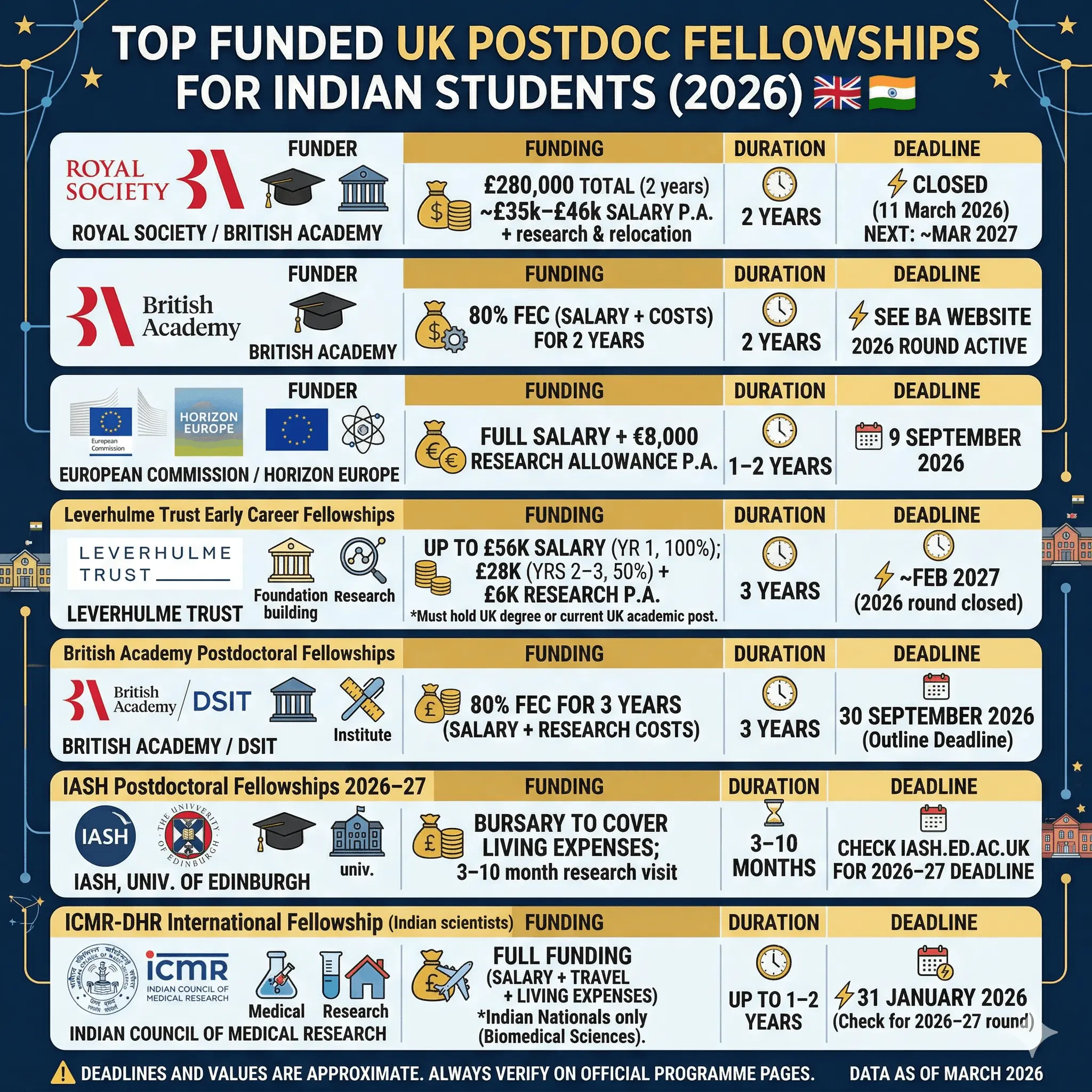
  • Top Funded Postdoctoral Fellowships in UK for Indian Students in 2026

    Top Funded Postdoctoral Fellowships in UK for Indian Students in 2026

    Research Opportunities · 2026

    Top Funded Postdoctoral Fellowships in UK for Indian Students in 2026

    A comprehensive, verified guide to fully funded UK postdoc fellowships open to Indian and international researchers — with stipends, deadlines, and direct application links.

    📅 Updated March 2026 ✍️ IR Research Publication Editorial Team 🎓 Early-Career Researchers

    Introduction: Why Pursue a Postdoc in the UK?

    For Indian PhD holders aiming to build a globally competitive research career, the United Kingdom remains one of the most sought-after destinations. Home to world-ranked universities like Oxford, Cambridge, Imperial College London, and Edinburgh, the UK offers early-career researchers access to cutting-edge laboratories, interdisciplinary networks, and prestigious fellowship programmes that can define an entire academic career.

    The good news: several fully funded postdoctoral fellowships in the UK are explicitly open to international applicants, including Indian researchers. These are not merely stipends — they cover full salaries, research expenses, visa costs, and sometimes even relocation support for dependents.

    This guide is for Indian PhD holders and early-career researchers who want to apply for funded research positions in the UK in 2026. We have compiled only genuine, verified programmes with official sources, current deadlines (where available), and direct application links. No fabricated opportunities — just real funding you can act on.

    💡 Who Should Read This
    This guide is for: PhD holders from Indian universities seeking postdoctoral funding in the UK; researchers in STEM, humanities, and social sciences; early-career academics within 5–8 years of their PhD award; and Indian students currently based at UK institutions exploring domestic fellowship routes.

    For more scholarship opportunities, explore our related guides on Fully Funded PhD Positions in UK for Indian Students 2026 (Complete Guide + List), Fully Funded Postdoctoral Fellowships in Canada for Indian Students in 2026 [Complete Guide], and our Fully Funded PhD in Australia: The Ultimate 2026 Scholarship Guide for Indian Students.

    Summary Table: Top Funded UK Postdoc Fellowships 2026

    Use the table below to quickly compare programmes by funding, eligibility, and deadlines before reading full details.

    Fellowship Host / Funder Eligible for Indians? Funding / Stipend Duration 2026 Deadline Apply
    Newton International Fellowship Royal Society / British Academy ✅ Yes — all non-UK nationals Up to £280,000 total (2 yrs); ~£35k–£46k salary p.a. + research & relocation 2 years 11 March 2026 (closed; next ~Mar 2027) royalsociety.org
    British Academy International Fellowships British Academy ✅ Yes — non-UK nationals (humanities/social sci) 80% FEC (salary + costs) for 2 years 2 years See BA website; 2026 round active thebritishacademy.ac.uk
    MSCA Postdoctoral Fellowships (European PF) European Commission / Horizon Europe ✅ Yes — any nationality (must host at UK institution) Full salary + €8,000 research allowance p.a. 1–2 years 9 September 2026 rea.ec.europa.eu
    Leverhulme Trust Early Career Fellowships Leverhulme Trust ⚠️ Conditional — must hold a UK degree OR current UK academic post (≥4 months before deadline) Up to £56k salary (yr 1, 100%); £28k (yrs 2–3, 50%) + £6k research p.a. 3 years ~Feb 2027 (2026 round closed) leverhulme.ac.uk
    British Academy Postdoctoral Fellowships British Academy / DSIT ⚠️ Must be based at a UK host institution for duration 80% FEC for 3 years (salary + research costs) 3 years 30 September 2026 (outline deadline) thebritishacademy.ac.uk
    IASH Postdoctoral Fellowships 2026–27 Institute for Advanced Studies in the Humanities, Univ. of Edinburgh ✅ Yes — open internationally Bursary to cover living expenses; 3–10 month research visit 3–10 months Check iash.ed.ac.uk for 2026–27 deadline iash.ed.ac.uk
    ICMR-DHR International Fellowship (Indian scientists) Indian Council of Medical Research ✅ Indian nationals only (biomedical sciences) Full funding (salary + travel + living expenses) Up to 1–2 years 31 January 2026 (check for 2026–27 round) icmr.nic.in

    Note: Deadlines are accurate as of March 2026. Always verify on the official programme page before applying, as schemes may update their timelines.

    1. Newton International Fellowships — Royal Society & British Academy

    Fellowship #1 · Fully Funded · STEM + Humanities
    Newton International Fellowships 2026
    ⏱ 2 Years 💷 Up to £280,000 🌍 All non-UK nationals 📅 March 2026 (closed; next ~2027)

    The Newton International Fellowship is arguably the most prestigious early-career postdoctoral fellowship available to international researchers wanting to work in the UK. Jointly administered by the Royal Society (for natural sciences) and the British Academy (for humanities and social sciences), it provides two fully funded years at a UK research institution.

    Key Benefits:

    • Total funding of up to £280,000 over two years (covering salary, research costs, overhead, and visa/relocation expenses)
    • Salary range approximately £35,608–£46,049 per annum (Cambridge IoA scale, as an indicator)
    • Annual research expenses of up to £8,000
    • One-off relocation payment (including support for dependents accompanying the Fellow)
    • Fast-track Global Talent Visa route for successful applicants
    • Access to alumni networking funding after the fellowship ends
    • Approximately 30 fellowships awarded per round, with potential for additional awards

    Eligibility for Indian researchers: Open to all non-UK nationals. Applicants must hold a PhD (or have successfully defended their doctoral thesis) by the application deadline, and must have no more than 5 years of active full-time postdoctoral experience (career breaks excluded). Applicants must not have resided or carried out research in the UK for more than 3 months during the 12 months before the deadline.

    Who should apply: Indian scientists and researchers in natural sciences (STEM) — or humanities/social sciences researchers applying via the British Academy route — who are in the first 5 years of their postdoctoral career and have a strong research proposal developed with a UK-based sponsor.

    Important for 2026: The 2026 round deadline was 11 March 2026. The next round is anticipated around March 2027. Contact info@newtonfellowships.org for eligibility queries.

    Visit Official Page →

    2. British Academy International Fellowships

    Fellowship #2 · Fully Funded · Humanities & Social Sciences
    British Academy International Fellowships 2026
    ⏱ 2 Years 💷 80% FEC 🌍 Non-UK nationals only 📅 2026 round active — check BA website

    The British Academy International Fellowships programme is co-run with the Royal Society and supports outstanding early-career researchers in the humanities and social sciences who wish to conduct research at a UK institution for two years.

    Key Benefits:

    • Two-year fellowship at a UK host institution in humanities or social sciences
    • Award offered at 80% Full Economic Cost (FEC) — covering salary, directly allocated and indirect costs
    • Alumni funding available post-fellowship for continued networking
    • Access to the British Academy’s international research community

    Eligibility: Must hold a PhD (or be completing it), be working outside the UK, not hold UK citizenship, be competent in English, and have no more than 5 years of active postdoctoral experience. Must have a clearly defined research proposal agreed with a UK host researcher.

    Who should apply: Indian researchers in history, sociology, economics, political science, linguistics, philosophy, cultural studies, and related fields who are in the early stages of their postdoctoral career and have secured a UK mentor willing to host them.

    Visit Official Page →

    3. MSCA Postdoctoral Fellowships (European Fellowship — UK Host)

    Fellowship #3 · Fully Funded · All Disciplines · Any Nationality
    Marie Skłodowska-Curie Actions (MSCA) Postdoctoral Fellowships 2026
    ⏱ 1–2 Years 💶 Full salary + €8k research allowance 🌍 Any nationality 📅 9 September 2026

    The MSCA Postdoctoral Fellowships, funded under the EU’s Horizon Europe programme, are among the largest and most competitive international postdoctoral funding schemes in the world. UK universities remain eligible as host institutions, making this a prime option for Indian researchers who wish to work at institutions such as Oxford, Cambridge, UCL, or Imperial College London.

    Key Benefits:

    • Full living allowance (salary) + annual research, training and networking allowance of €8,000
    • Mobility allowance if relocating internationally
    • Family allowance if applicable
    • Open to researchers of any nationality (for European Fellowships hosted at a UK institution)
    • Total budget for the 2026 call: €399.05 million
    • Fellowship duration of 1–2 years; up to 8 years of research experience post-PhD permitted

    Eligibility: Must hold a PhD by the deadline. Maximum 8 years of full-time research experience post-PhD. Must comply with mobility rules: must not have resided or carried out main activity in the country of the host for more than 12 months in the 36 months before the deadline. The 2026 call opens 9 April 2026 with a deadline of 9 September 2026.

    Who should apply: Indian postdoctoral researchers in any discipline — from life sciences and engineering to social sciences and humanities — who can identify a supervisor at a UK institution willing to co-develop and host the application.

    How to find a UK host: Explore hosting offers on EURAXESS, or contact UK research departments directly. Many UK universities publish expressions of interest calls specifically for MSCA candidates.

    Visit Official Page →

    4. Leverhulme Trust Early Career Fellowships

    Fellowship #4 · Highly Competitive · Any Discipline · Conditional Eligibility
    Leverhulme Early Career Fellowships 2026
    ⏱ 3 Years 💷 Up to £56k salary (yr 1) + £6k research ⚠️ UK degree OR active UK post required 📅 ~Feb 2027 (2026 round now closed)

    The Leverhulme Trust Early Career Fellowships are among the most prestigious postdoctoral fellowships available within the UK. Approximately 145 fellowships are awarded per year across all disciplines. Each award is tenable for 3 years, with a significant salary contribution and annual research expenses.

    Key Benefits:

    • Year 1: Trust covers 100% of Fellow’s salary up to £56,000
    • Years 2–3: Trust covers 50% of salary up to £28,000 per year (host institution covers the balance)
    • Up to £6,000 per year in research expenses
    • Non-renewable 3-year award tenable at any eligible UK university or HEI
    • Approximately 145 fellowships available per round

    ⚠️ Eligibility note for Indian researchers: This is a competitive scheme primarily designed for researchers building a UK academic career. Applicants must either hold a degree from a UK higher education institution, or hold an active academic position (fixed-term lectureship or fellowship) in the UK for at least 4 months before the closing date. Indian PhD holders based in India who have never held a UK post or UK degree are not directly eligible. However, Indian researchers who completed their PhD at a UK university or who currently hold a UK postdoctoral position are encouraged to apply.

    Who should apply: Indian researchers who obtained their PhD at a UK university, or who currently hold a postdoctoral appointment in the UK and are within 4 years of PhD thesis submission.

    Visit Official Page →

    5. British Academy Postdoctoral Fellowships

    Fellowship #5 · 3-Year Award · Humanities & Social Sciences
    British Academy Postdoctoral Fellowships 2026
    ⏱ 3 Years 💷 80% FEC for 3 years 📍 Must be at a UK host institution 📅 30 September 2026 (outline deadline)

    The British Academy Postdoctoral Fellowship is a prestigious 3-year award in the humanities and social sciences, funded by the UK’s Department for Science, Innovation and Technology (DSIT). It starts from Autumn 2027 (for the 2026 application round). The primary emphasis is on completing a significant publishable research project.

    Key Benefits:

    • Funds 80% of salary costs, directly allocated and indirect costs under Full Economic Cost
    • 3-year non-renewable fellowship at a UK university or recognised research institution
    • Designed to lead toward a permanent academic post
    • Integrated into the scholarly community at the host institution

    Eligibility: Applicants must be based at an eligible UK university or research organisation for the duration of the fellowship. This is suitable for Indian researchers who are already in the UK (e.g., on a postdoctoral contract) or who can secure affiliation with a UK host institution. The 2026 submission deadline (UK institutional approval) is 30 September 2026 (17:00 GMT).

    Who should apply: Indian researchers currently based at a UK university in humanities or social sciences, within 3 years of their PhD viva, who have a mentor and a significant independent research project to pursue.

    Visit Official Page →

    6. IASH Postdoctoral Fellowships 2026–27 — University of Edinburgh

    Fellowship #6 · Fully Open Internationally · Arts, Humanities & Social Sciences
    IASH Postdoctoral Fellowships 2026–27 (University of Edinburgh)
    ⏱ 3–10 Months 💷 Bursary (living expenses) 🌍 International applicants welcome 📅 Check iash.ed.ac.uk for 2026–27

    The Institute for Advanced Studies in the Humanities (IASH) at the University of Edinburgh offers competitive postdoctoral fellowships for scholars in the arts, humanities, and social sciences. The fellowships provide a research visit of 3 to 10 months in Edinburgh, with no teaching obligation.

    Key Benefits:

    • 3–10 month funded research visit at the University of Edinburgh
    • Bursary to contribute toward living expenses (can top up another fellowship such as British Academy)
    • No mandatory teaching — full focus on independent research
    • Access to Edinburgh’s vibrant international humanities community
    • Specialised targeted fellowships available (Gender Studies, Digital Humanities, Islamic Studies, 18th-Century Scottish Studies)
    • Open to applicants from within and beyond the University of Edinburgh

    Eligibility: Must hold a doctorate at the time of application, normally awarded within the last 3 years (graduates between 2023 and 2026, with flexibility for career breaks). Must not have held a permanent university position or a previous IASH Fellowship.

    Who should apply: Indian scholars in arts, humanities, and social sciences who completed their PhD within the last 3 years and wish to pursue 3–10 months of independent research in Edinburgh. Ideal for those who can combine the IASH bursary with other funding sources.

    Visit Official Page →

    7. ICMR-DHR International Fellowship for Indian Biomedical Scientists

    Fellowship #7 · Indian Nationals Only · Biomedical Sciences
    ICMR-DHR International Fellowship Programme for Indian Biomedical Scientists
    ⏱ Up to 1–2 Years 💷 Fully funded (salary + travel) 🇮🇳 Indian nationals only 📅 Check icmr.nic.in for 2026–27 round

    The ICMR-DHR International Fellowship is a Government of India programme administered by the Indian Council of Medical Research (ICMR) under the Department of Health Research (DHR). Unlike the other fellowships in this list, this one funds Indian scientists to go abroad — including to the UK — for advanced research in biomedical sciences.

    Key Benefits:

    • Fully funded (covers salary/stipend, international travel, accommodation, and living expenses)
    • Allows Indian biomedical scientists to conduct research at international laboratories, including those in the UK
    • No need to independently identify UK fellowship funding — the Government of India supports the placement
    • Strong credibility signal for future Indian academic career

    Eligibility: Open to Indian nationals only working in biomedical sciences. Applicants should be associated with Indian research institutions and meet ICMR’s academic qualification criteria. The 2025 deadline was 31 January 2026 — monitor the ICMR website for the 2026–27 cycle announcement.

    Who should apply: Indian biomedical researchers, medical scientists, and early-career faculty who want to spend time at a world-class UK laboratory without having to independently compete for UK-based funding. Also see our guide on funded research positions for Indian scientists abroad.

    Visit Official Page →

    How to Apply for UK Postdoc Fellowships from India: Key Tips

    Competition for these fellowships is intense. Here are evidence-based strategies to strengthen your application as an Indian researcher:

    1. Identify and Contact a UK Sponsor/Mentor Early

    Almost all UK postdoctoral fellowships — Newton, MSCA, Leverhulme, British Academy — require a named UK-based sponsor or mentor before you can apply. Do not wait until the deadline. Reach out 4–6 months in advance with a concise research proposal email, a CV, and a list of publications.

    2. Craft a Compelling and Independent Research Proposal

    Your proposal should present a new research direction, not merely extend your PhD thesis. Fellowship committees look for originality, feasibility, and clear academic impact. The Newton Fellowship and MSCA in particular emphasise your potential for research independence.

    3. Choose the Right Fellowship for Your Career Stage

    • 0–5 years post-PhD: Newton International Fellowship, British Academy International Fellowship, IASH
    • 0–8 years post-PhD: MSCA Postdoctoral Fellowship
    • Already in UK, 0–4 years post-PhD: Leverhulme ECF, British Academy Postdoctoral Fellowship
    • Biomedical scientists: ICMR-DHR Fellowship (Government of India route)

    4. Is IELTS Required?

    Most UK postdoctoral fellowships do not require a formal IELTS score, as they assess English proficiency through your research proposal and communication with the UK sponsor. However, for visa purposes, you may need to demonstrate English language competence. Check with UK Visas and Immigration for the Global Talent Visa requirements.

    5. Apply for the Global Talent Visa

    Newton International Fellows and many MSCA fellows qualify for a fast-track Global Talent Visa route, which significantly simplifies the UK immigration process. Start this process as soon as your fellowship offer is confirmed.

    Frequently Asked Questions

    Q1. Are there postdoctoral fellowships in the UK open to Indian students?
    Yes. Several major UK fellowships explicitly welcome non-UK nationals, including Indian researchers. The Newton International Fellowship (Royal Society / British Academy), MSCA Postdoctoral Fellowship (Horizon Europe, UK host), and IASH Postdoctoral Fellowships (University of Edinburgh) are all open to applicants of any nationality, including Indian citizens. Some — like the Leverhulme Early Career Fellowship — have conditional eligibility requiring a UK degree or current UK academic position.
    Q2. How much stipend do UK postdoctoral fellowships offer?
    Stipends vary significantly by programme. The Newton International Fellowship covers a full academic salary (approximately £35,000–£46,000 per year based on the Cambridge scale), plus research expenses and relocation support, for a total of up to £280,000 over two years. The MSCA Postdoctoral Fellowship covers the full salary set by the host institution plus an €8,000 annual research allowance. The Leverhulme Fellowship covers up to £56,000 in year one and £28,000 per year in years two and three.
    Q3. Which UK universities offer fully funded postdoc fellowships for international researchers?
    Most research-intensive UK universities can host international postdoctoral fellows through the programmes listed above. Leading host institutions include the University of Oxford, University of Cambridge, University College London (UCL), Imperial College London, University of Edinburgh, King’s College London, and the University of Manchester. The key is to find a named academic sponsor at your chosen institution before applying.
    Q4. What are the eligibility criteria for UK postdoctoral fellowships?
    Common eligibility requirements across most UK postdoctoral fellowships are: (a) Holding a PhD or having successfully defended your doctoral thesis by the application deadline; (b) Being within a set number of years of your PhD award (typically 5 years for Newton/British Academy International, up to 8 years for MSCA, up to 4 years for Leverhulme); (c) Not being a UK citizen (for internationally targeted fellowships like Newton); (d) Proposing high-quality, original, publishable research; and (e) Having secured a named UK academic sponsor or mentor.
    Q5. Do UK postdoc fellowships provide visa sponsorship?
    Yes. Most fully funded UK postdoctoral fellowships include immigration support. Newton International Fellows, for example, qualify for the fast-track Global Talent Visa route. MSCA fellows also receive support through the host institution’s HR departments. Relocation costs — including visa application fees — are often covered by the fellowship award itself.
    Q6. Can PhD holders from India apply for the Newton International Fellowship?
    Yes, absolutely. The Newton International Fellowship is open to all non-UK nationals, and Indian PhD holders are among the eligible applicants. You must hold your PhD (or have successfully defended your thesis) by the application deadline, have no more than 5 years of active full-time postdoctoral experience, and be currently working outside the UK. You must secure a UK-based academic sponsor before applying through the Royal Society or British Academy portals.
    Q7. What is the best fully funded postdoc option in UK for Indian researchers in 2026?
    For researchers in natural sciences (STEM), the Newton International Fellowship (Royal Society) is the gold standard — prestigious, well-funded, and fully open to Indian nationals. For humanities and social sciences researchers, the British Academy International Fellowship is the equivalent. If you are already based in the UK, explore the Leverhulme Trust Early Career Fellowships and the British Academy Postdoctoral Fellowship. For biomedical scientists based in India, the Government of India’s ICMR-DHR International Fellowship is a strong option that funds your placement abroad without requiring you to independently win UK funding.
  • Fully Funded Postdoctoral Fellowships in Canada for Indian Students in 2026 [Complete Guide]

    Fully Funded Postdoctoral Fellowships in Canada for Indian Students in 2026 [Complete Guide]

    Fully Funded Postdoctoral Fellowships in Canada for Indian Students in 2026 [Complete Guide]
    🍁 Canada Research Guide 2026

    Fully Funded Postdoctoral Fellowships in Canada for Indian Students in 2026 [Complete Guide]

    Everything Indian researchers need to know about finding, applying for, and winning top postdoc funding in Canada — from federal government awards to cutting-edge AI fellowships.

    📅 Updated: March 2026 | ⏱ 18 min read | 🎓 Postdoctoral Level

    Why Canada Is a Top Destination for Indian Postdoctoral Researchers in 2026

    Canada has firmly established itself as one of the most welcoming and research-rich destinations for international postdoctoral scholars. For Indian researchers who have recently completed their PhD, the country offers a powerful combination of world-class universities, generous federal funding, strong India-Canada research partnerships, and a clear pathway to long-term residence.

    In 2025–2026, the Canadian government and major research funding bodies made landmark changes to their postdoctoral funding ecosystem. The Banting, NSERC, CIHR, and SSHRC postdoctoral fellowships were consolidated into a single harmonised program called the Canada Postdoctoral Research Award (CPRA). Simultaneously, Mitacs launched the brand-new Accelerate Global Excellence Award specifically to attract international talent — including Indian researchers — to Canadian industry-academic partnerships.

    This guide covers every major fully funded postdoctoral fellowship opportunity available to Indian students in Canada for 2026, with verified details on stipends, eligibility, deadlines, and official links. Whether you are a scientist in STEM, a health researcher, or a social science scholar, there is a program designed for you.

    🎯 Who This Guide Is For:
    • Indian nationals who have completed a PhD (or expect to within 12 months)
    • Postdoctoral researchers currently in Canada on a work permit
    • Early-career scientists looking to transition to independent research careers
    • Researchers in STEM, health sciences, social sciences, AI, and engineering
    🏛️

    World-Class Universities

    Canada is home to University of Toronto, McGill, UBC, and other globally ranked institutions with cutting-edge research infrastructure.

    💰

    Competitive Stipends

    Most funded fellowships offer CAD $55,000–$110,000 per year — significantly higher than equivalent programs in many other countries.

    🇮🇳🇨🇦

    India–Canada Partnerships

    Mitacs renewed its partnership with India in March 2026, opening more bilateral research collaboration pathways for Indian scholars.

    🌐

    Immigration Pathways

    Postdoctoral experience in Canada can strengthen PR applications through Express Entry and other immigration streams.

    Quick Comparison: Top Postdoctoral Fellowships in Canada for Indian Students 2026

    The table below summarises the most important details for each fellowship. All values are in Canadian Dollars (CAD) unless stated.

    # Fellowship / Program Host Institution Open to Indians? Stipend / Value Duration Deadline (2026) Official Link
    1 Canada Postdoctoral Research Award (CPRA) Any eligible Canadian university / research hospital ✓ Yes (up to 20%) $70,000/year Up to 2 years ~September 2026 Apply →
    2 Mitacs Accelerate Global Excellence Award Canadian universities + industry partners ✓ Yes (targeted) $85,000/year (total $170K over 2 yrs) 2 years May 1, 2026 Apply →
    3 Mitacs Accelerate (Industry Postdoc) Canadian universities + partner organisations ✓ Yes (with work permit) $60,000–$75,000/year Up to 3 years Rolling Apply →
    4 Eric & Wendy Schmidt AI in Science PDF (U of T) University of Toronto ✓ International eligible ~$85,000–$110,000/year + benefits 2 years (3rd year possible) ~October 2026 Apply →
    5 U of T Postdoctoral Competitive Research Award University of Toronto ✓ International eligible Competitive — approx. $70,000+/year 2 years Check U of T SGS Apply →
    6 Schmidt Science Fellows Program Any approved global institution (incl. Canadian) ✓ Open globally US$110,000/year Up to 2 years July 2026 (U of T nominees) Apply →
    7 IVADO Postdoctoral Fellowships (AI/Data Science) IVADO-affiliated institutions, Quebec ✓ International eligible ~$100,000/year Specified in call Check IVADO website Apply →
    8 Canada Government Postdoctoral Research Program Federal govt labs & research institutions ✓ Open (varies) ~$70,000/year 1–3 years Feb–Mar 2026 (next cycle TBA) Apply →

    ⚠️ Deadlines are approximate based on previous cycles. Always verify on official program pages before applying. Some programs run annual competitions; check official sites for 2026–27 cycle openings.

    Detailed Guide to Each Fellowship

    1. Canada Postdoctoral Research Award (CPRA)

    🇨🇦 Federal Government
    Administering Bodies
    CIHR, NSERC, SSHRC
    Annual Stipend
    CAD $70,000 per year
    Duration
    Up to 24 months
    Expected Deadline
    ~September 2026 (annual)
    International Quota
    Up to 20% of all awards

    The Canada Postdoctoral Research Award (CPRA) is the flagship tri-agency postdoctoral program launched in 2025, replacing the former Banting, NSERC, SSHRC, and CIHR fellowship programs. It is administered jointly by Canada’s three major research funding bodies and represents one of the most prestigious and generous postdoctoral awards available in the country.

    For Indian Students: Up to 20% of all CPRA awards are reserved for international applicants, making Indian PhD holders directly eligible to apply. The award must be held at an eligible Canadian university, research hospital, or non-profit research organization.

    Eligibility Highlights:

    • Must hold or expect to hold a doctorate before the award start date
    • PhD must have been completed within the last 3 years (extensions granted for career interruptions, parental leave, etc.)
    • Cannot hold a concurrent tri-agency research training award
    • Cannot have previously received a CIHR, NSERC, or SSHRC postdoctoral award
    • Apply to the agency whose mandate matches your field (CIHR = health; NSERC = natural sciences/engineering; SSHRC = social sciences/humanities)

    Key Benefits:

    • $70,000 CAD per year — among the highest federal postdoc stipends available
    • Freedom to pursue research at any eligible Canadian institution of your choice
    • Strong credential for future faculty and leadership roles
    • Access to supplementary funding through joint initiatives and priority areas
    🔗 Visit Official CPRA Page

    2. Mitacs Accelerate Global Excellence Award

    🌍 New for 2026 — Ideal for Indian Researchers
    Administering Body
    Mitacs (federal non-profit)
    Total Award Value
    CAD $170,000 over 2 years
    Duration
    2 years
    Application Deadline
    May 1, 2026
    Awards Available
    60 (50 + 10 CIFAR)

    The Mitacs Accelerate Global Excellence Award is a brand-new, landmark initiative launched in March 2026, specifically designed to attract outstanding international postdoctoral researchers — including Indian scientists — to Canada. Mitacs also renewed its formal partnership with India in March 2026, signalling a strong commitment to India-Canada research collaboration.

    This award is especially exciting for Indian researchers because it focuses on high-impact commercial sectors — AI, quantum technology, clean energy, advanced manufacturing, defence, cybersecurity, agri-tech, and health/life sciences — that align closely with India’s own research strengths.

    Eligibility Highlights:

    • Open to international postdoctoral researchers currently outside Canada (including Indians)
    • Must be within 5 years of PhD completion at the project start date
    • Must be eligible for postdoctoral fellow status at a Canadian institution
    • Canadians and permanent residents returning from abroad are also eligible
    • Must collaborate with a Canadian industry partner (for-profit, non-profit, hospital, or municipality)

    Key Benefits:

    • CAD $170,000 total funding over 2 years (jointly funded by Mitacs + industry partner)
    • Covers salary, research costs, and relocation expenses from India to Canada
    • Direct industry connection — invaluable for career development
    • If not selected for Global Excellence, may be offered the standard Mitacs Accelerate Postdoc award ($60K/year)
    • Additional 10 fellowships in partnership with CIFAR (Canadian Institute for Advanced Research)
    🔗 Visit Mitacs Global Excellence Page

    3. Mitacs Accelerate (Industry Postdoc)

    🏭 For Postdocs Already in Canada
    Administering Body
    Mitacs
    Annual Funding
    CAD $60,000–$75,000/year
    Duration
    Up to 3 years
    Application Deadline
    Rolling (open throughout year)

    The Mitacs Accelerate Industry Postdoc is the standard postdoctoral track within Mitacs’s flagship Accelerate program. Unlike the Global Excellence Award (targeted at newcomers), this track is ideal for Indian researchers who are already based in Canada on a valid work permit or study visa and wish to pursue applied research with a Canadian partner organization.

    Eligibility Highlights:

    • International postdoctoral fellows with a valid Canadian work permit are eligible
    • PhD completion must be within 5 years of the project start date
    • Must be registered at a Mitacs partner university in Canada
    • Cannot be a full-time employee of the partner organization

    Key Benefits:

    • CAD $60,000–$75,000 per year in combined Mitacs + partner funding
    • Rolling deadline — apply anytime, no fixed annual competition window
    • Flexible across any academic discipline
    • Strong networking with Canadian industry; many fellows convert to permanent employment
    🔗 Explore Mitacs Programs

    4. Eric & Wendy Schmidt AI in Science Postdoctoral Fellowship (University of Toronto)

    🤖 AI + Natural Sciences
    Host Institution
    University of Toronto
    Annual Salary
    CAD ~$85,000–$110,000 + benefits
    Duration
    2 years (3rd year possible)
    Application Deadline
    ~October 2026 (4th cohort)
    Fields
    Natural sciences, engineering, mathematics, computing

    The Eric and Wendy Schmidt AI in Science Postdoctoral Fellowship at the University of Toronto is one of Canada’s most prestigious and well-funded postdoctoral opportunities, backed by a $148 million donation from Schmidt Futures. It is part of a global network of nine elite universities and is co-led by U of T’s Data Sciences Institute and Acceleration Consortium.

    This fellowship is ideal for Indian researchers with a PhD in the natural sciences, engineering, mathematics, or computing who are eager to integrate AI methodologies into their research domain. Prior AI experience is not required — curiosity and willingness to learn are.

    Eligibility Highlights:

    • PhD in natural sciences, engineering, mathematics, or computing
    • International candidates must complete PhD before their fellowship start date
    • PhD completion no earlier than January 2023 (with flexibility for career interruptions)
    • Must secure a primary supervisor with a full-time U of T appointment
    • Cannot concurrently hold another postdoctoral fellowship

    Key Benefits:

    • Among Canada’s highest postdoc salaries, plus full benefits package
    • Access to world-leading AI infrastructure including Vector Institute resources
    • Interdisciplinary community of Schmidt AI Fellows across nine global universities
    • Option for a third year including global research placements or industry internships
    🔗 Visit Schmidt AI Fellows Page

    5. Schmidt Science Fellows Program

    🌍 Global Prestige Award
    Administering Body
    Schmidt Sciences + Rhodes Trust
    Annual Stipend
    US$110,000/year (~CAD $150,000)
    Duration
    Up to 2 years
    Nomination Deadline (U of T)
    July 13, 2026
    Fields
    Natural sciences, engineering, mathematics, computing

    The Schmidt Science Fellows Program is one of the most globally prestigious fellowships for early-career interdisciplinary scientists. Delivered in partnership with the Rhodes Trust, it supports exceptional PhD graduates who commit to a disciplinary pivot — pursuing postdoctoral research in a fundamentally different field from their PhD at any approved institution worldwide, including top Canadian universities.

    Indian nationals who complete their PhD at the University of Toronto can be nominated for this competitive global award. The hallmark is the “pivot” — fellows must demonstrate bold interdisciplinary ambition.

    Eligibility Highlights:

    • PhD in natural sciences, engineering, mathematics, or computing
    • For U of T nominees: PhD thesis accepted between May 2026 and June 2027
    • Must start fellowship in July 2027 or October 2027 (cohort start dates are firm)
    • Must propose a genuine disciplinary pivot from PhD research

    Key Benefits:

    • US$110,000/year — one of the highest postdoctoral stipends in the world
    • Complete freedom to choose placement institution worldwide
    • Exclusive cohort-based Science Leadership Program and global summits
    • Access to a network of 150+ Fellows from 34 nationalities
    🔗 Visit Schmidt Science Fellows

    6. IVADO Postdoctoral Fellowships (AI and Data Science)

    🧠 AI Research — Quebec
    Host Institution
    IVADO-affiliated Quebec institutions
    Annual Value
    ~CAD $100,000/year
    Duration
    Specified per call
    Application Deadline
    Check IVADO website for new calls

    The IVADO Postdoctoral Fellowship is offered through the Institut de valorisation des données (IVADO), a major data science and AI research consortium based in Montreal, Quebec. IVADO seeks outstanding national and international postdoctoral researchers to contribute to its flagship initiative on Robust, Reasoning, and Responsible AI (IAR³).

    Montreal is home to one of the world’s densest AI research ecosystems, making this an exceptional opportunity for Indian AI and data science researchers. Quebec also offers distinct immigration pathways through the PRTQ program.

    Who Should Apply:

    • Researchers with a PhD in machine learning, data science, statistics, operations research, or related fields
    • Those interested in robust, ethical, and explainable AI
    • International researchers willing to be based in Quebec for the duration
    🔗 Visit IVADO Funding Page

    7. National Research Council Canada (NRC) — Postdoctoral Research Program

    🔬 Federal Labs
    Host Institutions
    NRC federal labs & research centres
    Annual Stipend
    ~CAD $70,000/year
    Duration
    1–3 years
    Application Period
    Feb–Mar 2026 (check for new cycle)

    The National Research Council of Canada (NRC) Postdoctoral Research Program places researchers in federal government laboratories and research institutions across Canada. These positions offer the unique experience of working on applied government-funded research with direct relevance to national policy, industry, and societal challenges.

    Note: While international applicants can participate in NRC postdoc programs, the CPRA program (above) specifically cannot be held at Canadian federal government institutions. NRC positions are applied to separately through the NRC careers portal.

    Key Benefits:

    • Access to unique federal research infrastructure not available at universities
    • Research areas including energy, health, agriculture, AI, and manufacturing
    • Competitive compensation with government benefits
    🔗 NRC Postdoc Careers Page

    Top Tips for Indian Researchers Applying for Canadian Postdoc Fellowships

    Competition for funded postdoctoral positions in Canada is intense. Here is what consistently separates successful applicants from the rest:

    🔍 Identify Your Supervisor First

    Most Canadian postdoc fellowships require a confirmed or prospective host supervisor before you apply. Reach out to faculty 6–9 months before application deadlines.

    📝 Tailor Your Research Proposal

    For CPRA and Schmidt AI, the research proposal is the most weighted component. Align your proposed project with the host institution’s strategic priorities.

    🏛️ Choose the Right Tri-Agency Stream

    For CPRA, select NSERC (science/engineering), CIHR (health), or SSHRC (social sciences/humanities) carefully — submitting to the wrong agency disqualifies your application.

    📅 Watch Internal Deadlines

    Universities often have internal review deadlines 2–4 weeks before the agency deadline. Missing the internal deadline means missing the competition entirely.

    🇮🇳 Leverage India-Canada MoUs

    India’s SERB, DST, and ICMR have bilateral agreements with Canadian agencies. Check whether your research area qualifies for co-funded opportunities.

    📄 Register Your CCV Early

    For CPRA applications, you must register a Canadian Common CV (CCV) through the tri-agency portal. Allow at least 2 weeks to complete it properly.

    Eligibility Summary: What Indian Applicants Need to Know

    Indian nationals applying for postdoctoral positions in Canada are generally treated as “international applicants.” Below is a snapshot of the key eligibility requirements that most directly affect Indian researchers:

    General Requirements for International (Indian) Postdoc Applicants in Canada:
    • PhD Completion: Most programs require your PhD to be completed no more than 3–5 years before the fellowship start date.
    • Work Permit: You will need a valid Canadian work permit. Most universities help postdocs obtain this through a Labour Market Impact Assessment (LMIA) exemption under CUSMA/International Agreements.
    • English Proficiency: No formal test required, but all applications, proposals, and references must be in English (or French for Quebec programs).
    • Supervisor Endorsement: All major fellowships require a letter of support from your proposed Canadian supervisor.
    • No Active Tenure-Track Position: You cannot hold a faculty or tenure-track position at the time of application.

    Canadian Immigration for Indian Postdoctoral Researchers

    One of the most compelling reasons for Indian researchers to choose Canada for their postdoc is the country’s progressive immigration pathways. A Canadian postdoctoral appointment can significantly strengthen your long-term immigration prospects:

    • Open Work Permit: Most postdoctoral fellows qualify for an LMIA-exempt Open Work Permit under the International Agreements category.
    • Express Entry: A postdoc in Canada counts as skilled Canadian work experience, increasing your Comprehensive Ranking System (CRS) score.
    • Provincial Nominee Programs (PNP): Provinces like Ontario, British Columbia, and Quebec have streams specifically for international researchers and graduates.
    • Global Skills Strategy: Canada’s fast-track work permit processing (as little as 2 weeks) applies to highly skilled workers, including postdoctoral researchers.

    Frequently Asked Questions (FAQ)

    ❓ Can Indian students apply for postdoctoral fellowships in Canada without being a permanent resident?
    Yes. Most Canadian postdoctoral fellowships explicitly welcome international applicants, including Indian nationals. You will need a valid work permit, which your host institution typically assists in obtaining. Programs like the CPRA reserve up to 20% of awards for international candidates. The Mitacs Global Excellence Award was specifically designed to bring international talent like Indian researchers to Canada.
    ❓ What is the difference between the old Banting Fellowship and the new CPRA program?
    The Banting Postdoctoral Fellowship, along with the NSERC, CIHR, and SSHRC postdoctoral fellowships, were all sunset after the 2024–25 competition cycle. They have been replaced by the Canada Postdoctoral Research Award (CPRA), a new harmonised tri-agency program launched in 2025. The CPRA offers $70,000/year (similar to the old Banting stipend), accepts both Canadian and international applicants, and has three streams managed by CIHR, NSERC, and SSHRC respectively. Up to 20% of awards go to international candidates.
    ❓ How long do I have after my PhD to apply for Canadian postdoc fellowships?
    Most programs allow you to apply within 3 to 5 years of completing your PhD:
    • CPRA: PhD completed within 3 years before the application deadline (extensions for parental leave, illness, etc.)
    • Mitacs (all programs): Within 5 years of PhD completion
    • Schmidt AI (U of T): PhD completed no earlier than January 2023
    • Schmidt Science Fellows: PhD accepted within the cycle’s specified window
    ❓ Do I need a job offer or a supervisor before applying for postdoc fellowships in Canada?
    For most competitive fellowships — yes. The CPRA, Mitacs, and Schmidt AI programs all require a confirmed or proposed host supervisor in Canada. You should identify a supervisor who supports your research goals and can endorse your application. However, university-level positions (advertised as regular postdoc jobs) often do not require pre-arranged funding — the supervisor has independent funding for your salary. Check individual university job boards like Academic Jobs Online and University Affairs Canada.
    ❓ Which Canadian universities have the highest success rates for international postdoc fellowship applications?
    Institutions with the strongest track records for competitive postdoc fellowship placement include:
    • University of Toronto — Hosts Schmidt AI Fellows, strong CPRA record, multiple dedicated postdoc awards
    • University of British Columbia (UBC) — Strong CPRA and Mitacs pipeline; active international postdoc community
    • McGill University — Offers Differential Fee Waivers for international students; strong in health and life sciences
    • University of Waterloo — Particularly strong in AI, quantum, and engineering; active Mitacs partnerships
    • University of Alberta — Growing research budget; strong in energy and environmental sciences
    ❓ Is the Mitacs Accelerate Global Excellence Award only for AI researchers?
    No, but it is focused on specific high-impact commercial sectors. Eligible fields include AI, quantum, clean technology, advanced materials and manufacturing, defence, cybersecurity, agri-tech, and health and life sciences. If your research falls within these areas (broadly defined), you are eligible. The award is not limited to AI researchers — it includes anyone whose work has commercialization potential in these sectors.
    ❓ What is the average postdoctoral salary in Canada for international researchers in 2026?
    Salaries vary significantly by program, institution, and discipline:
    • Minimum (unfunded, university minimum): CAD $40,000–$50,000/year
    • CPRA / Standard funded: CAD $70,000/year
    • Mitacs programs: CAD $55,000–$75,000/year
    • Schmidt AI (U of T): CAD $85,000–$110,000/year + benefits
    • Schmidt Science Fellows: US$110,000/year (~CAD $150,000)
    Note that some provinces (especially Ontario and British Columbia) have minimum postdoc salary floors set by collective agreements.

    Key Official Resources for Indian Postdoc Applicants

    Start Your Canadian Research Journey in 2026

    Canada’s postdoctoral ecosystem in 2026 is more open, better funded, and more internationally connected than ever before. Whether you are drawn by the CPRA’s federal prestige, the Mitacs Global Excellence Award’s industry connections, or the Schmidt AI Fellowship’s cutting-edge research environment, the opportunities for Indian researchers are extraordinary.

    The most important next step is identifying a supervisor who shares your research vision. Once you have that, the rest of the application falls into place.

    🍁 Best of luck with your Canadian postdoctoral journey!

    Disclaimer: All information in this article is accurate as of March 2026 and sourced from official program pages. Fellowship programs, deadlines, and funding amounts are subject to change. Always verify details directly on official government and university websites before applying. This guide does not constitute professional immigration or legal advice.